What a Miniature Dachshund Really Costs You, From Puppy Day to Senior Years

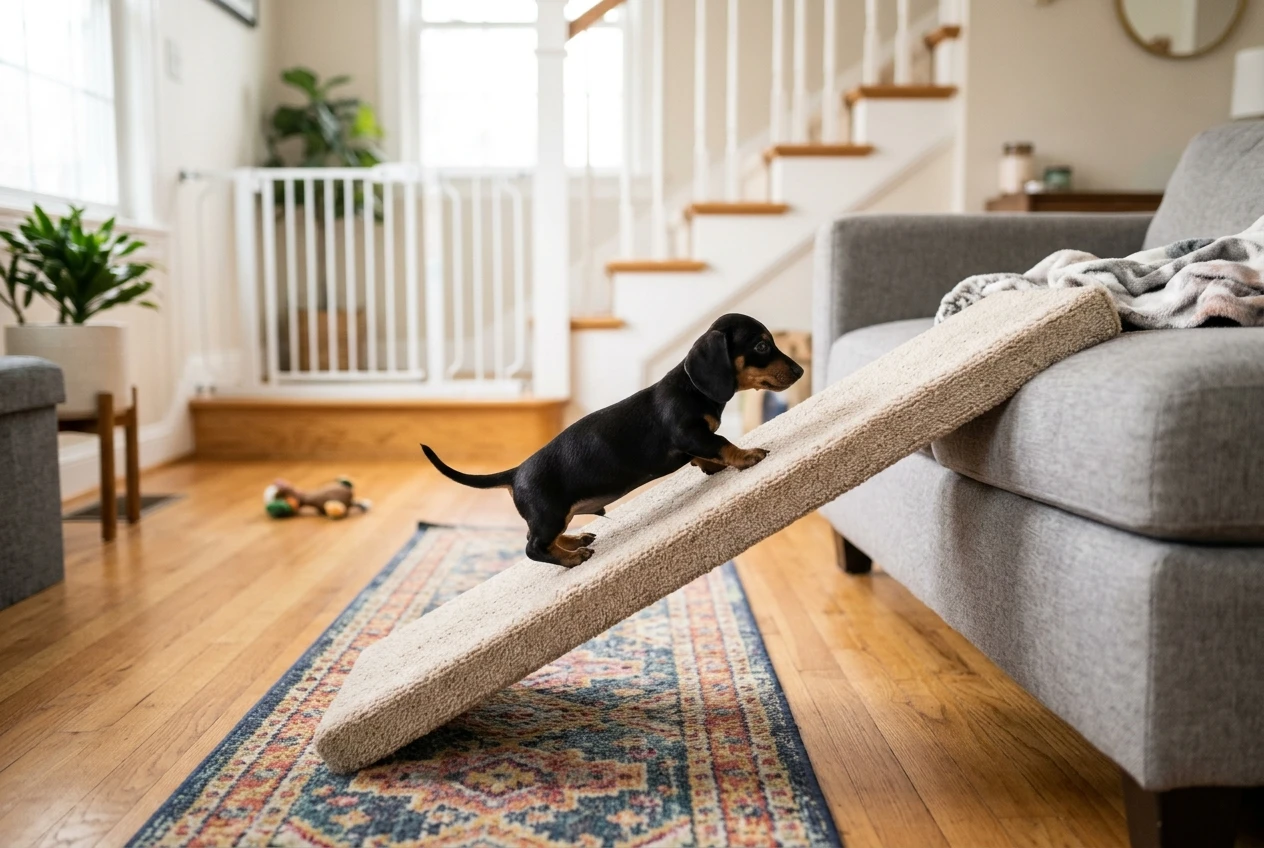
A red miniature Dachshund puppy stands at the bottom of a carpeted pet ramp leading up to a cream sofa, with an open wire crate with a plaid bed and a small chest harness lying on the

The Puppy Price Is Just the Start of the Budget

When families ask how much a miniature Dachshund costs, they usually mean the price of the puppy. That number matters, but it is the smallest part of what you will spend over a dog’s life. Miniature Dachshunds often live well into their teens, so you are planning for twelve to sixteen years of food, vet visits, supplies and care.

This guide does not quote dollar amounts, because prices in your area, your vet’s fees and your dog’s health will differ from anyone else’s. Instead, it lists every cost category in the order you will meet them and shows you how to price each one with real quotes from businesses near you. By the end you will have a monthly figure and a yearly figure that belong to your family, not an average from somewhere else.

One more point before the categories. The purchase price and the lifetime cost are linked. A puppy from health-tested parents, raised with good care, can mean fewer unplanned vet bills later. The last section covers that, and it is worth reading before you compare prices between breeders. If you are still deciding on a breeder, our guide to how to vet a Dachshund breeder covers the questions to ask.

The First-Year Shopping List: Crate, Bed, Ramps, Harness and Puppy Supplies

The first year has the biggest cluster of one-time purchases. Most of these items can be priced in an afternoon of browsing online and in local pet stores.

Here is what a Dachshund household usually needs:
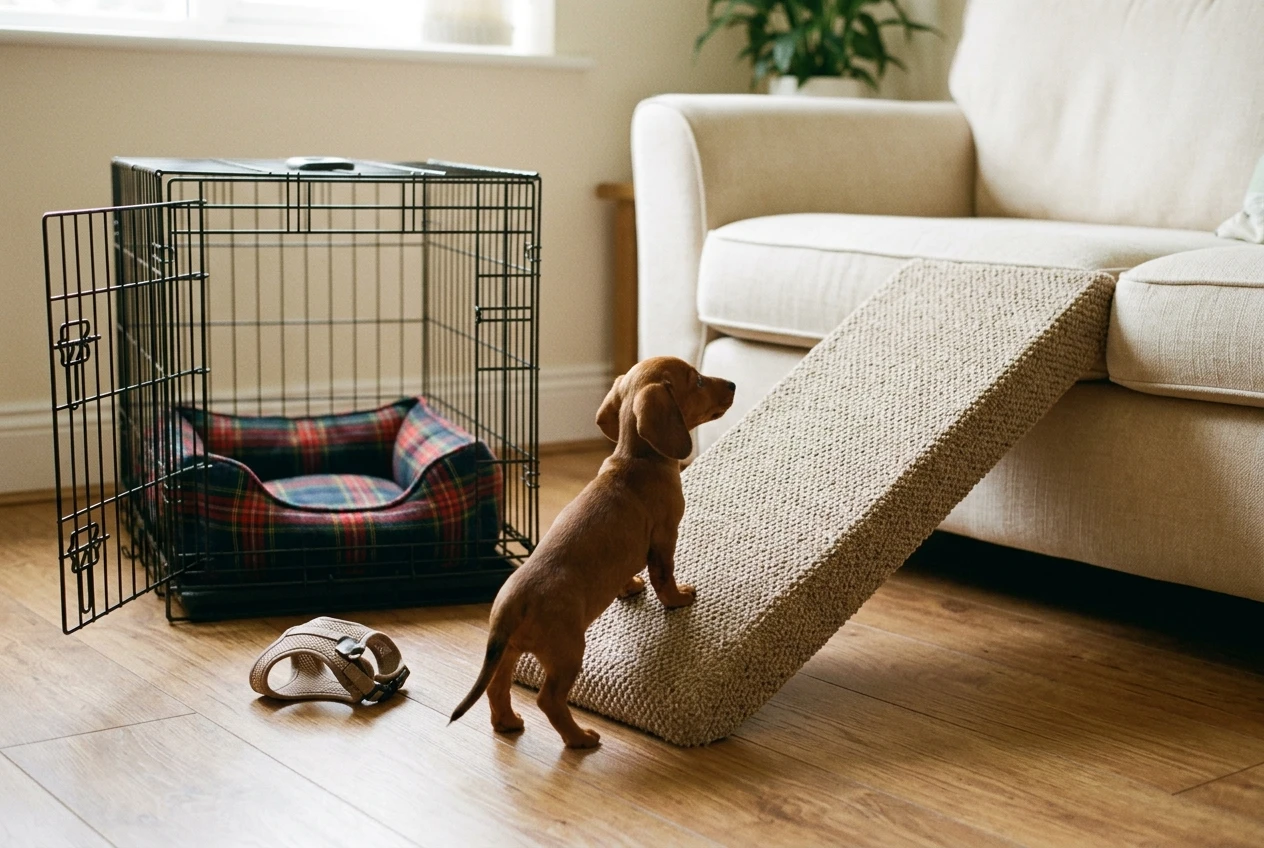
A red miniature Dachshund puppy stands at the bottom of a carpeted pet ramp leading up to a cream sofa, with an open wire crate with a plaid bed and a small chest harness lying on the wooden floor beside it, in soft morning window light.
  • A crate sized for an adult miniature, with a divider if you want to use it for a growing puppy. Buying one that fits the adult dog saves you from buying twice.
  • A bed and washable bedding. Buy a spare cover so one can be in the wash.
  • A pen or gates to keep the puppy in a safe area while you cannot watch.
  • Ramps or pet stairs for the couch and bed. Dachshunds have long backs and short legs, and jumping on and off furniture is something most owners try to limit.
  • A harness instead of a collar for walks. A well-fitted harness spreads pressure across the chest instead of the neck. Puppies outgrow their first harness, so plan to buy a second size.
  • Leash, ID tag and a microchip registration if the chip is not already registered to you.
  • Bowls, a slow feeder if your vet recommends one, and a food storage container.
  • Toys and chews suited to a small mouth.
  • Cleaning supplies for accidents, especially an enzyme cleaner made for pet messes.
  • Nail clippers or a grinder, a soft brush, and dog toothpaste and a toothbrush.

Price each item twice: once for a basic version and once for a sturdier one. Then pick the version that fits your family and write down that number.

Expect to replace some of these. Puppies chew beds, outgrow harnesses and wear out toys, so carry a small replacement line in your yearly budget.

Food, Treats and Chews: The Monthly Cost That Never Stops

Food is the cost you will pay every month for the dog’s entire life. A miniature Dachshund eats little compared with a large breed, which keeps the bag cost manageable, but the quality you choose changes the price per bag a great deal.

To price this line, look at three things:

  1. The cost of the bag you intend to buy and how many days it lasts for a small dog. The feeding guide on the bag gives a starting amount, and your vet can adjust it.
  2. Treats and training rewards. Puppies in training go through a lot of small treats, so budget for them separately from meals.
  3. Chews and dental products, which wear out and need regular replacing.

Divide the bag price by the number of days it lasts, then multiply by thirty. That gives you a monthly food figure from your actual local price. Add treats and chews to it.
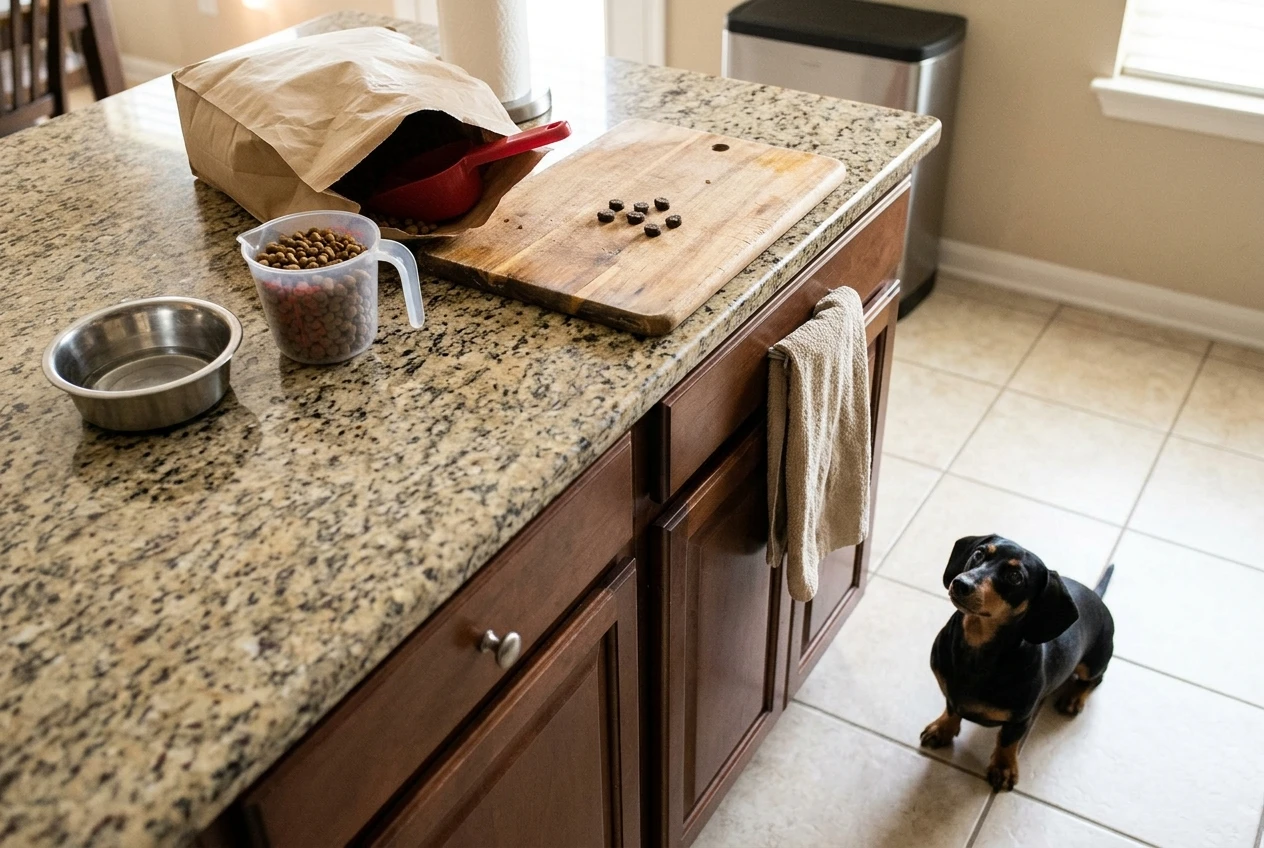
A kitchen counter with a measuring cup of kibble beside a small stainless steel dog bowl, a scoop in an open food bag, and a few small training treats on a wooden board, while a miniature Dachshund sits politely on the tile floor looking up.

Weight matters here more than in many breeds. Extra weight puts added strain on a Dachshund’s long spine, so measuring meals and keeping treats in check is a health habit as well as a budget one. If you want to see how one breeder approaches feeding, you can read what we feed our dogs. Ask your own vet before you switch foods, since your dog’s age and health may call for something different.

Vet Care You Can Plan For: Vaccines, Preventives, Dental Cleanings and Spay or Neuter

Routine vet care is the most predictable medical cost, because most of it follows a schedule. Call two or three local clinics and ask for their fee lists. Many will give you a puppy package price over the phone.

Plan for these lines:

  • Puppy exams and the vaccine series. Puppies need several visits in their first months, and each visit usually has its own exam fee.
  • Yearly exams and booster vaccines for the adult dog.
  • Heartworm testing and prevention, given monthly in most regions.
  • Flea and tick prevention, also usually monthly and sometimes seasonal depending on where you live.
  • Fecal tests and deworming, most common in the puppy months.
  • Spay or neuter surgery. Ask the clinic what the quote includes, such as pre-surgery bloodwork, pain medication and the follow-up check. Also ask your vet when they recommend scheduling it for a Dachshund, since timing advice can vary.
  • Dental care. Small breeds are prone to tartar and gum disease. Many dogs need a professional cleaning under anesthesia at some point, and the quote can change if extractions are needed. Daily brushing at home can help, and our guide to grooming a Dachshund at home walks through teeth, ears and nails.

Ask each clinic one more question: what does an exam cost when the dog is sick between regular visits? Knowing that number ahead of time makes an unplanned visit easier to absorb.

The Cost Families Forget: Back Problems, Emergencies and Pet Insurance

This is the category that surprises families most. Dachshunds are among the breeds at higher risk of intervertebral disc disease, often called IVDD, where a disc in the spine bulges or ruptures and presses on the spinal cord. Signs range from pain and reluctance to jump up to wobbling or loss of use of the back legs. Treatment can mean rest and medication for milder cases, or specialist imaging and surgery for serious ones.
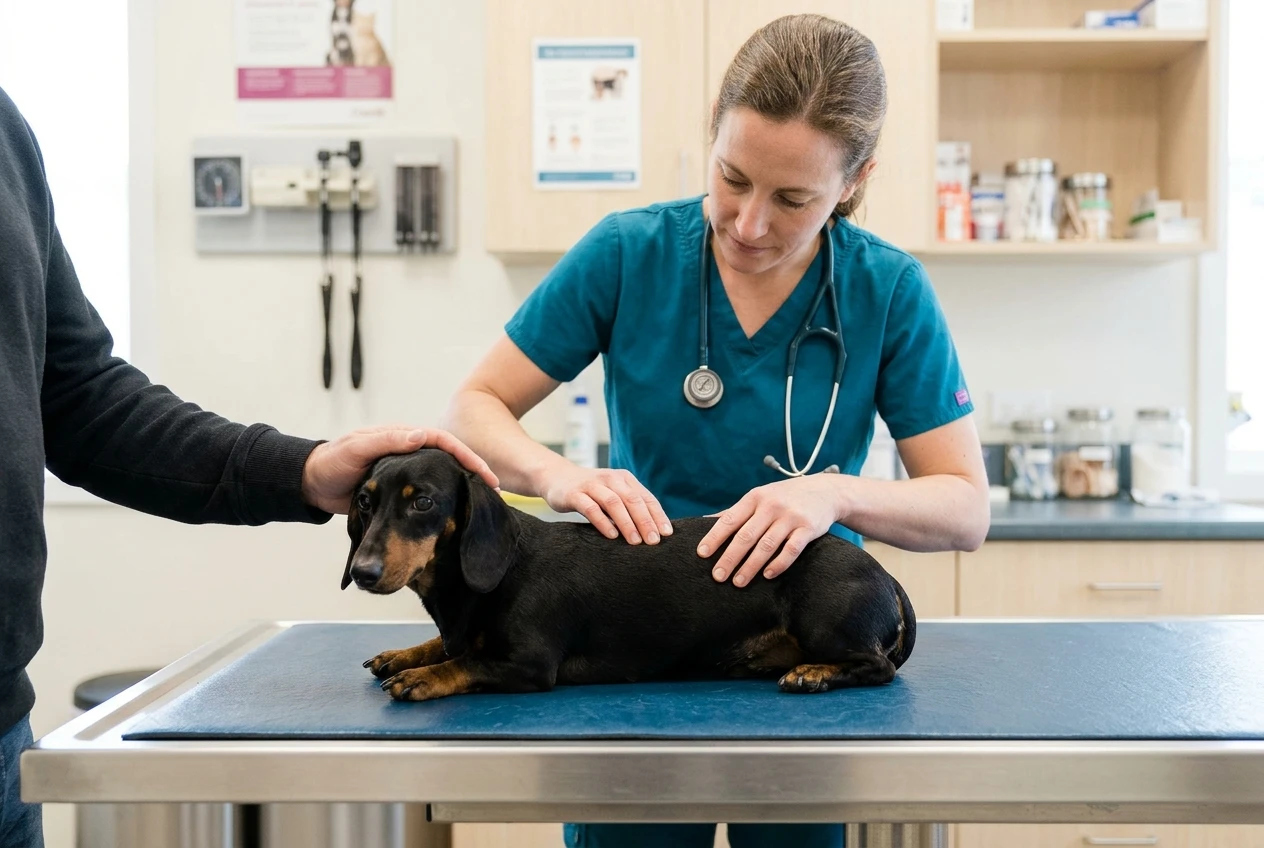
A veterinarian in a teal scrub top gently examines the back of a black-and-tan miniature Dachshund lying on a padded exam table in a bright clinic, the dog's long spine and short legs clearly visible, the owner's hand resting reassuringly on its head.

You cannot predict whether your dog will have a problem, and you cannot price it from a single number. You can, however, find out the range in your area:

  • Call your nearest emergency vet and a veterinary specialty hospital and ask what an initial emergency exam costs and what spinal imaging typically costs there.
  • Ask what surgery and recovery care generally cost, and whether they offer payment plans.
  • Ask whether they accept third-party financing.

Then decide how you will cover it. Families usually pick one of three routes, or a mix: a pet insurance policy, a dedicated savings account, or a credit line for emergencies.

If you look at insurance, read the policy details carefully:

  • Waiting periods before coverage starts for illness or injury.
  • Pre-existing condition rules, which usually exclude anything that showed signs before the policy began.
  • Whether back and spine conditions are covered, and whether any breed-related limits apply.
  • Annual and lifetime limits, deductibles and reimbursement percentage.
  • Whether the plan pays the clinic directly or reimburses you afterward.

Enrolling while the dog is young and healthy is the usual advice, since conditions that appear later are then not pre-existing. Get written quotes from a few providers for a miniature Dachshund puppy in your zip code and put the monthly premium in your budget.

Daily habits also reduce risk. Keeping your dog lean, limiting jumping and using ramps all help, and our guide to protecting your Dachshund’s back covers them in detail.

Everyday Extras: Grooming, Training Classes, Boarding and Pet Sitters

Beyond food and medical care, a few services add to the yearly total, and they vary with your coat type and your lifestyle.

Grooming. Smooth-coated Dachshunds need very little, and many families handle brushing, baths and nails themselves. Longhaired and wirehaired coats need more regular brushing, and wirehaired coats may need occasional professional work. Ask a local groomer for a quote for your coat type and how often they suggest visits. Even if you groom at home, price a nail trim at the vet or groomer as a fallback.

Training. Dachshunds are smart and strong-willed, and house training can take patience. A puppy class helps with socialization and basic manners. Look up local class fees and note how many weeks a session runs. If you want to understand what you are signing up for, read what living with a Dachshund is really like.

Boarding and pet sitters. If your family travels, you will need a plan for the dog. Get quotes from a boarding kennel and a pet sitter, then multiply the nightly rate by the number of nights you expect to be away each year. Ask about extra fees for holidays, medication or additional dogs.

Other recurring costs to check: your city or county dog license, a replacement tag, and any home changes such as a fence repair or a gate for stairs.

Senior Dachshund Years: What Changes and What to Set Aside

Many Dachshunds reach their senior years in good spirits, and the cost pattern shifts as they age. Most veterinarians suggest more frequent checkups for older dogs, often twice a year, and bloodwork to catch problems early. Ask your clinic what their senior wellness package includes and what it costs.
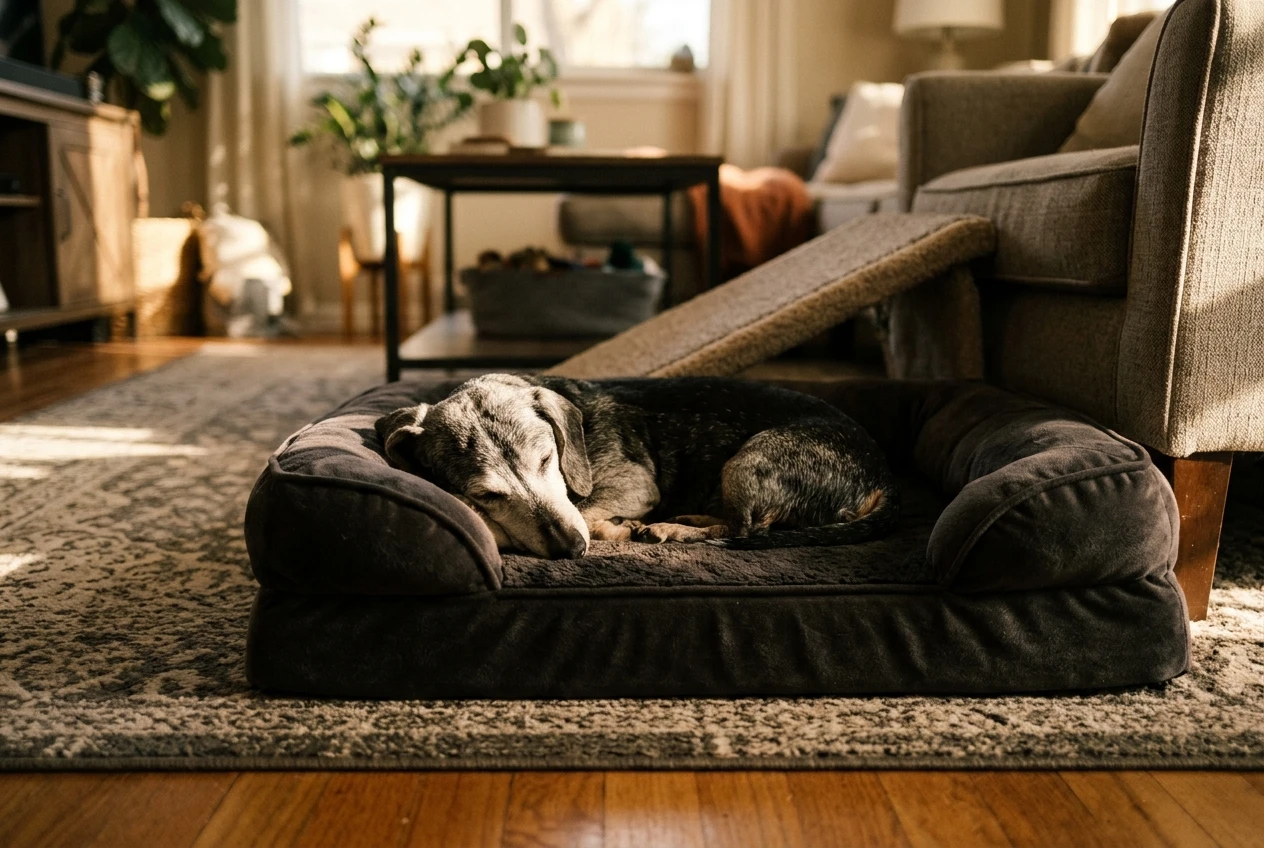
An older Dachshund with a gray-white muzzle curled up asleep on a thick orthopedic bed in a warm living room, a non-slip rug beneath it and a small ramp leading up to the nearby armchair, golden late-afternoon light.

Things to plan for as your dog ages:

  • More frequent exams and lab work.
  • Dental care, since years of tartar can lead to cleanings or extractions.
  • Joint and mobility support. Ask your vet about pain management, supplements and any therapies they recommend for an older dog with a long back.
  • Eye and heart changes, which can mean medication or specialist visits.
  • Home adjustments, such as non-slip rugs on hard floors, more ramps, orthopedic bedding and a harness with a handle for support.
  • Special diets if your vet recommends one for kidney, heart or weight reasons.
  • End-of-life care. This is hard to think about, but it is better to know the local costs of a gentle, in-clinic or at-home goodbye than to face the question for the first time in a crisis.

Pet insurance bought early may continue into the senior years, but check whether premiums rise with age and whether the policy has an age cap. If you are saving instead, the older years are when having that account matters most. Putting a small amount aside every month from the first year builds a cushion that is already there when you need it.

Build Your Own Dachshund Budget: A Simple Monthly and Yearly Worksheet

A family's kitchen table with a handwritten notebook page of columns and numbers, a pencil, a calculator, a coffee mug and a few printed vet fee sheets, while a miniature Dachshund rests its chin on the table edge, warm overhead light.

You can do this on paper or in a spreadsheet. Use a quote from a real local source for every line, and write down where the number came from so you can update it later.

Step 1: List your recurring monthly costs. Write one line for each and fill it with your quote:

  • Food
  • Treats and chews
  • Flea, tick and heartworm prevention
  • Pet insurance premium, if you choose it
  • Emergency savings contribution
  • Poop bags, cleaning supplies and other consumables

Step 2: List your yearly costs, then divide each by twelve.

  • Annual exam and booster vaccines
  • Dental cleaning or dental care products
  • Grooming or nail trims
  • License and registration
  • Boarding or pet sitter (nightly rate times expected nights)
  • Replacement gear, toys and bedding

Step 3: List your one-time costs. These are the first-year shopping list, the puppy series of vet visits, spay or neuter surgery, and any training class. Add them up and decide whether you will pay from savings or spread them across the first year.

Step 4: Add the totals.

  • Monthly recurring total, plus the yearly items divided by twelve, gives your monthly budget.
  • Monthly budget times twelve, plus one-time costs, gives your first-year budget.
  • Monthly budget times twelve gives your ongoing yearly budget for later years.

Step 5: Stress-test it. Take your emergency vet quotes from the back-health section and ask whether your family could pay that amount within a day or two, through insurance, savings or a payment plan. If the answer is no, adjust the plan now, before the puppy comes home.

Review the sheet every year. Prices change, and so does your dog.

How Health-Tested Parents and a Caring Breeder Can Help You Avoid Surprise Bills

No breeder can promise a dog will never get sick. What a careful breeder can do is lower the odds of problems that are known to run in families and give your puppy a good start.

When you compare breeders, ask these questions:

  • Which health tests were done on both parents, and can you see the results? For miniature Dachshunds, ask specifically about eye conditions such as progressive retinal atrophy, and ask what your breeder screens for in the spine and in the genetics of the line.
  • What do the parents’ own histories look like, including any back problems in the family line?
  • How are the puppies raised? Clean housing, regular vet checks, vaccines and deworming on schedule, and early handling all affect how a puppy starts out.
  • What do the puppies eat, and how do they grow? A lean, well-conditioned puppy is easier on a long spine than one that is overfed.
  • What does the breeder provide at pickup? Health records, a written contract and a plan for staying in touch after you go home are good signs.
  • Will the breeder take the dog back if you cannot keep it at any point in its life?

Health testing costs a breeder money, as do good food, vet care and clean facilities, so a puppy from this kind of program may cost more up front than one from a seller who skips them. That higher price can be worth it if it lowers the chance of an avoidable vet bill later, since a single serious medical event can cost more than the difference between two puppy prices. You can read more about what responsible breeding looks like in what ethical Dachshund breeding is and why it matters.

A budget made from your own quotes lets you decide with clear eyes, and a breeder who answers your questions openly helps you start well.

If your family has run the numbers and feels ready, take a look at our available puppies and send us an inquiry. We’d love to get to know you.
How to Vet a Dachshund Breeder: The Questions to Ask and the Signs to Walk Away From

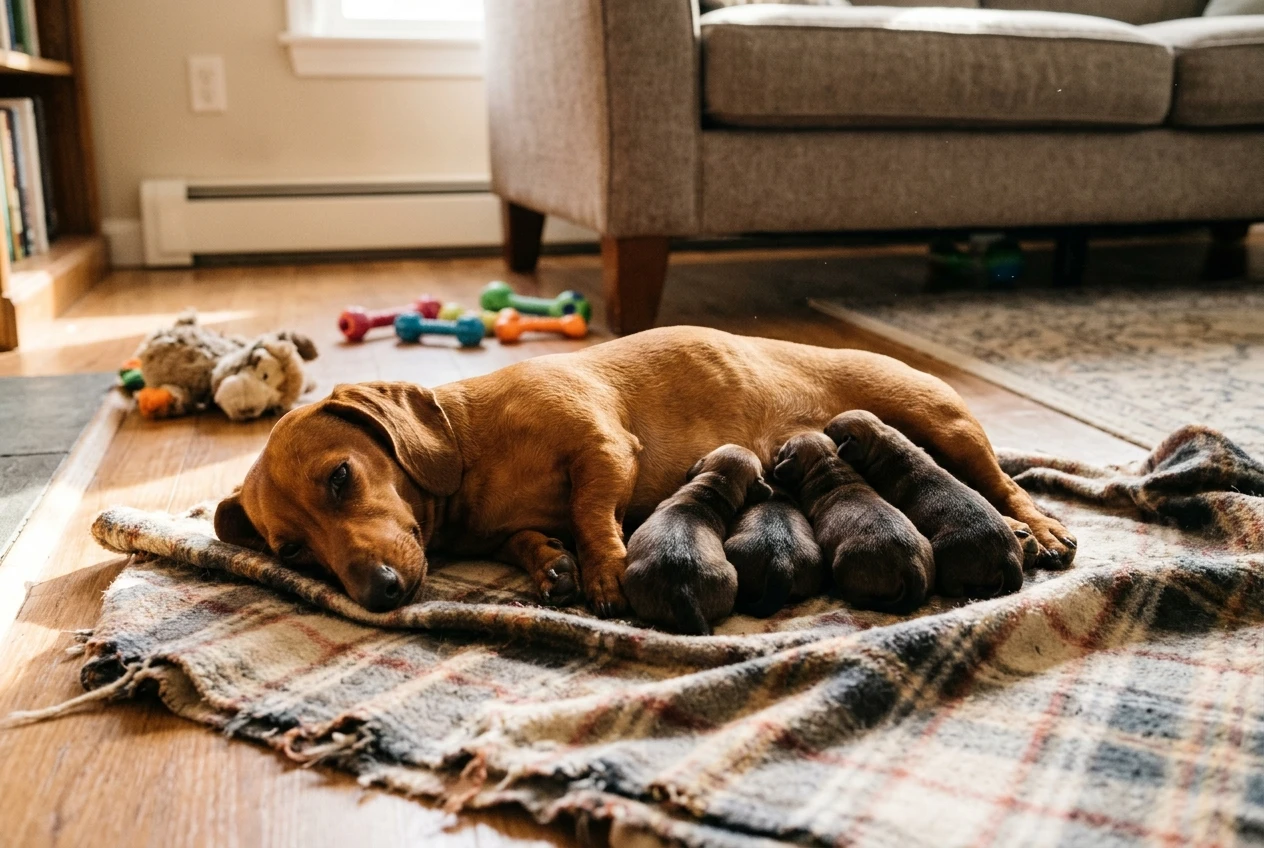
A smooth red Dachshund mother lying on a worn blanket in a sunny family living room, her litter of small puppies nestled against her, a sofa leg and a scattering of chew toys visibl

Choosing a Dachshund puppy starts with choosing the person who raised it. The breeder decides how the parents were chosen, how the puppies were handled in their first weeks, and whether anyone will answer your questions after you bring your puppy home. If you are working out how to find a reputable Dachshund breeder, the most useful thing you can do is learn what to look for before you fall in love with a photo.

This guide is a vetting checklist you can use on a first phone call or a visit. For each topic it covers what to ask, what a good answer sounds like, and which answers mean you should thank them for their time and keep looking. For the bigger picture of why breeding practices matter, our explainer on what ethical Dachshund breeding is covers it. This article is about what you do and say during the search.

Start With the Breeder, Not the Puppy

Before you call anyone, spend twenty minutes reading their website, social pages and ads. You can learn a lot about a breeder before you ever speak to them.

A good breeder’s page usually tells you who they are, where they are, and which Dachshund varieties they work with (smooth, longhaired, wirehaired, miniature or standard). It shows the actual parent dogs, by name, and explains what a family should expect from the process: how to inquire, whether there is a waitlist, and what the contract covers.

A smooth red Dachshund mother lying on a worn blanket in a sunny family living room, her litter of small puppies nestled against her, a sofa leg and a scattering of chew toys visible behind them in warm window light.

Look for these signs:

  • Photos of real dogs in a real home. Puppies on a lawn or kitchen floor that you can see belong to the same household, and photos of the mother with her litter.
  • Named parents. If you cannot tell which dogs the puppies come from, you cannot ask about their health or temperament.
  • Plain language about health. Specific mentions of the testing done on the parents are better than the words “vet checked” or “healthy.”
  • A way to contact them that is more than a text number. A phone number, an email and a general location are normal.

A few things on a page should slow you down. Stock-style photos, or photos with watermarks from other sites, may belong to someone else. You can run a picture through a reverse image search; if it turns up on several unrelated sites, treat the ad as a scam. Many different breeds listed for sale at once, prices listed with a “buy now” button, and a puppy shown against a plain background with no sign of where it lives should also make you cautious.

Red Flags That Should Make You Walk Away

Some warning signs are serious enough that you should stop the conversation, however cute the puppies are.

Puppies are always available

A breeder who has puppies ready every week of the year is likely running a volume operation. A Dachshund mother needs time to recover between litters, and a careful breeder plans litters around the dogs, not around a sales calendar. A breeder who lists several litters at once, or has puppies available on demand for any color you request, is selling a product.

No visits, no video calls

A breeder who will not show you where the puppies are raised is hiding something. Some breeders limit in-person visits for a legitimate reason: young puppies have not finished their vaccines, and visitors can carry germs in from other dogs. A responsible breeder who limits visits will still offer a live video call, show you the mother and the space, and invite you to meet the puppies once it is safe. A breeder who offers to meet you in a parking lot, deliver the puppy to a gas station, or ship the puppy sight unseen is a serious concern.

Pressure to pay quickly

Be suspicious of “three other families are looking at this puppy, so send the money today.” Urgency is how scammers and brokers get you to decide before you think. Payment methods matter too. Requests for gift cards, wire transfers or payment apps with no buyer protection are common in puppy scams. A genuine breeder gives you time to read the contract and ask questions.

Other warning signs

  • They will not name the parents or share their registration information.
  • They cannot say how old the puppies are or when they will be ready to go home. Puppies should stay with their mother and littermates until at least eight weeks old.
  • They dismiss health questions with “my dogs have never had a problem.”
  • They offer to sell you two puppies together at a discount, or push you to take a puppy you did not choose.
  • They have no contract or will not let you read it ahead of time.
  • The place smells strongly of urine, the dogs are dirty, or they keep the adult dogs hidden.
  • They sell through pet stores or a third party and cannot tell you where the puppies came from. A broker is a middleman who has often never seen where the puppy was born.

Green Lights Worth Looking For

Good breeders tend to look slower and more selective than you expect, and that is a good sign.

A waitlist. A waitlist usually means the breeder plans litters in advance and matches puppies with families instead of selling to the first buyer. Ask how long the wait usually is and how the order works. Waiting a few months for the right puppy is normal.

Questions for you. A breeder who cares where the puppy goes will ask about your home, your schedule, your children, your other pets and your experience with dogs. They may ask if you have stairs or furniture the puppy will jump on, since Dachshunds are prone to back injuries. They may ask who will be home during the day. If you are the only one asking questions, the breeder cares more about the sale than the puppy.

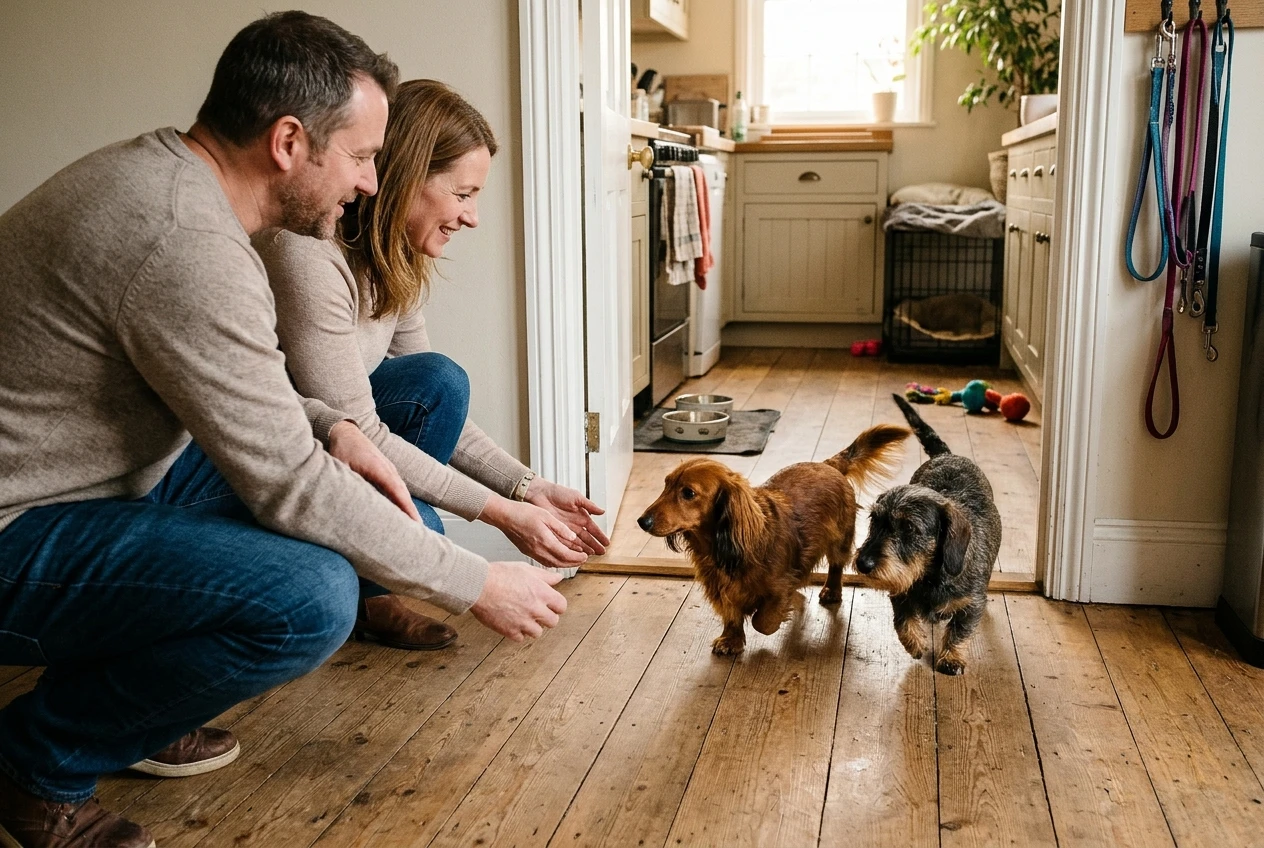
A breeder's kitchen doorway where a couple of adult Dachshunds, one longhaired and one wirehaired, trot out to greet two visiting adults crouching down with outstretched hands, wooden floor, soft afternoon light, relaxed and welcoming mood.

A home you can see. The best sign is a breeder who invites you to see the dogs where they live, either in person or by video. Dogs that live in the household, wander in and out of the kitchen, and greet visitors are usually well socialized.

Honest answers about downsides. A reputable breeder will tell you that Dachshunds bark, dig, resist house training and can be stubborn. They will also talk about back health without changing the subject. If you want a realistic picture yourself, our piece on what living with a Dachshund is really like is a useful read before you call.

Willingness to say no. A breeder who tells you a puppy might not be the right match, or that your home is not ready, is putting the dog first.

Questions to Ask on the First Call

Keep this conversation friendly. You are not interrogating anyone; you are getting to know the person who will be a resource for your puppy’s whole life. Here are questions to ask, with what a good answer sounds like.

“Can you tell me about the parents?” A good answer names the sire and dam, describes their temperament and size, and mentions their ages and health history. The breeder should be happy to talk about them at length.

“How many litters do you have each year, and how many breeds do you work with?” A good answer is a small number, with one or two breeds or varieties. Several breeds and many litters point to a commercial operation.

“How old is the mother, and how many litters has she had?” A good answer shows the mother is a healthy adult with time between litters. Be wary of a very young mother, a mother with many back-to-back litters, or a vague answer.

“What health testing have the parents had?” A good answer names specific tests and can show you the results. More on this in the next section.

“How are the puppies raised?” A good answer describes puppies raised in the house, handled daily from birth, and gradually introduced to household noises, other people and different floor surfaces.

“When can the puppies go home, and what will they have had by then?” A good answer is eight weeks or older, with a vet exam, first vaccines, deworming and often a microchip, all documented in writing.

“What do you feed the puppies, and what will you send home with us?” A good answer names the food so you can keep it consistent in the first days, and may include a blanket or toy that smells like home. Our breeder’s page on what we feed our dogs is an example of the kind of detail you can ask for.

“What happens if we can’t keep the puppy?” A good answer is a clear take-back policy. The breeder should want the dog returned to them instead of ending up in a shelter or with a stranger.

“Can I talk to someone who has one of your puppies?” A good answer is yes, with references from families or a vet. A breeder who has raised puppies with care usually has people happy to talk.

Health Testing and Vet Records

This is the area where the fewest buyers ask and where answers matter most. Dachshunds are prone to certain conditions, most famously intervertebral disc disease (IVDD), a back problem. Breeders cannot eliminate that risk, but they can work to reduce it through careful choices of parents, and they can help you protect the dog’s back at home. Our guide to protecting your Dachshund’s back covers daily habits that help.

What to ask to see for the parents

Ask which health tests have been done on both parents and ask to see the actual results, not just hear that they were done. Which tests are relevant depends on the coat type and variety, so ask the breeder to explain why they chose each one. Things worth asking about include:

  • Genetic tests for inherited conditions that affect Dachshunds. Depending on the variety, these can include eye conditions such as cord1 PRA, and Lafora disease in miniature wirehaired Dachshunds. There are also genetic tests related to back problems. Ask your breeder and your vet what each test means.
  • Eye exams by a veterinary eye specialist.
  • Knee (patella) checks and general orthopedic exams by a vet.
  • Results in a public database, when available. The Orthopedic Foundation for Animals (OFA) keeps a searchable public database of results that you can check yourself.

If you are looking at a dapple, ask the breeder how they avoid breeding two dapples together. Puppies that inherit the dapple gene from both parents (double dapples) are at higher risk of hearing and vision problems, and responsible breeders pair a dapple with a non-dapple.

What to ask to see for the puppies

  • A vet exam record with the date, the vet’s name and findings.
  • Vaccination and deworming dates, and what the next vaccines will be.
  • Microchip details, if the puppy has one, and how registration transfers to you.
  • Registration paperwork, and whether the puppy is registered with a recognized registry such as the AKC. Registration alone does not prove quality, but the papers should match the parents you were told about.

A good breeder is relaxed about these requests and will tell you what they know and do not know. A breeder who becomes defensive, or says “I do not believe in all that testing,” is giving you an answer.

What a Visit Should Look Like

If you can visit in person, treat it as a chance to observe. If the breeder limits visitors to protect young puppies, expect to meet them in a controlled way, such as outside, or to see the puppies by video first. Either way, here is what to look at.

The dogs. Adult dogs should look healthy: clear eyes, clean ears, a good body weight and a shiny coat. They should be friendly or at least calm around strangers, not terrified or frantically barking. Dachshunds are vocal, so some barking is normal, but trembling or hiding is not.

The space. The area where puppies live should be clean, dry and warm, with room to play and clean bedding. The puppies should have toys and be around the household. A kennel at the back of the property with no human contact is a different thing from a puppy pen in the family room.

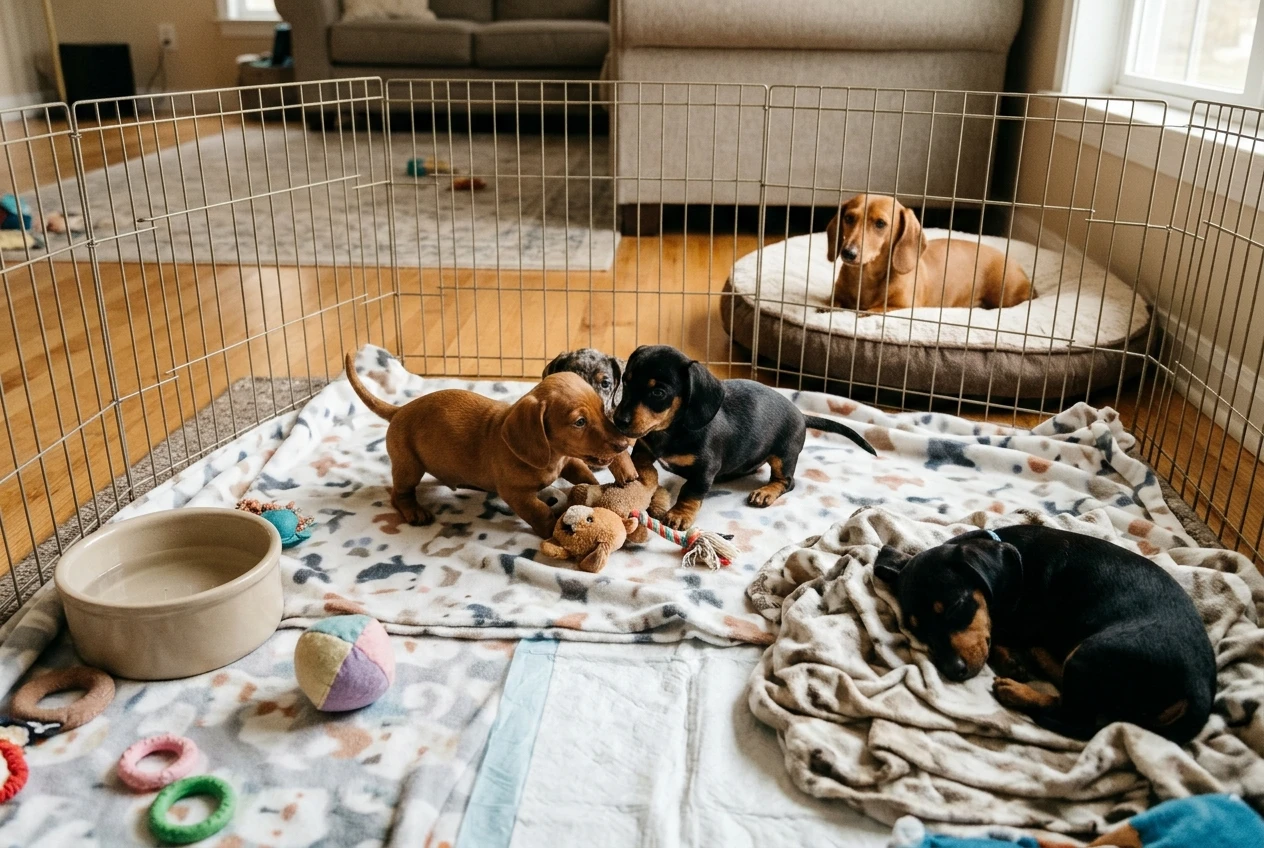
Close view of a clean puppy pen in a family room: fresh bedding, a shallow water bowl, small toys, and three plump, bright-eyed Dachshund puppies playing while one sleeps in a heap, with a mother dog calmly watching from a nearby dog bed.

The mother. Ask to meet the mother. She should be present, relaxed, in good condition and comfortable with her puppies. A mother who looks thin, exhausted or nervous is a concern. If the breeder says she is “away” or cannot be seen, ask why. The father may live elsewhere, particularly if the breeder used an outside stud, but the breeder should be able to tell you about him and show you photos and records.

The puppies. Healthy puppies are curious, plump without a swollen belly, and have clean eyes, ears and noses. They should have no crusty discharge or bald patches. At eight weeks, they should come toward you, play and then sleep deeply. A puppy that is listless, coughing or hiding in a corner needs a vet before it needs a new home.

The breeder’s behavior. Notice whether the breeder answers questions patiently, lets you handle the puppies gently, and encourages you to take your time.

Paperwork, Deposits and Support After You Go Home

A breeder’s paperwork shows how seriously they take their commitment to the puppy and to you.

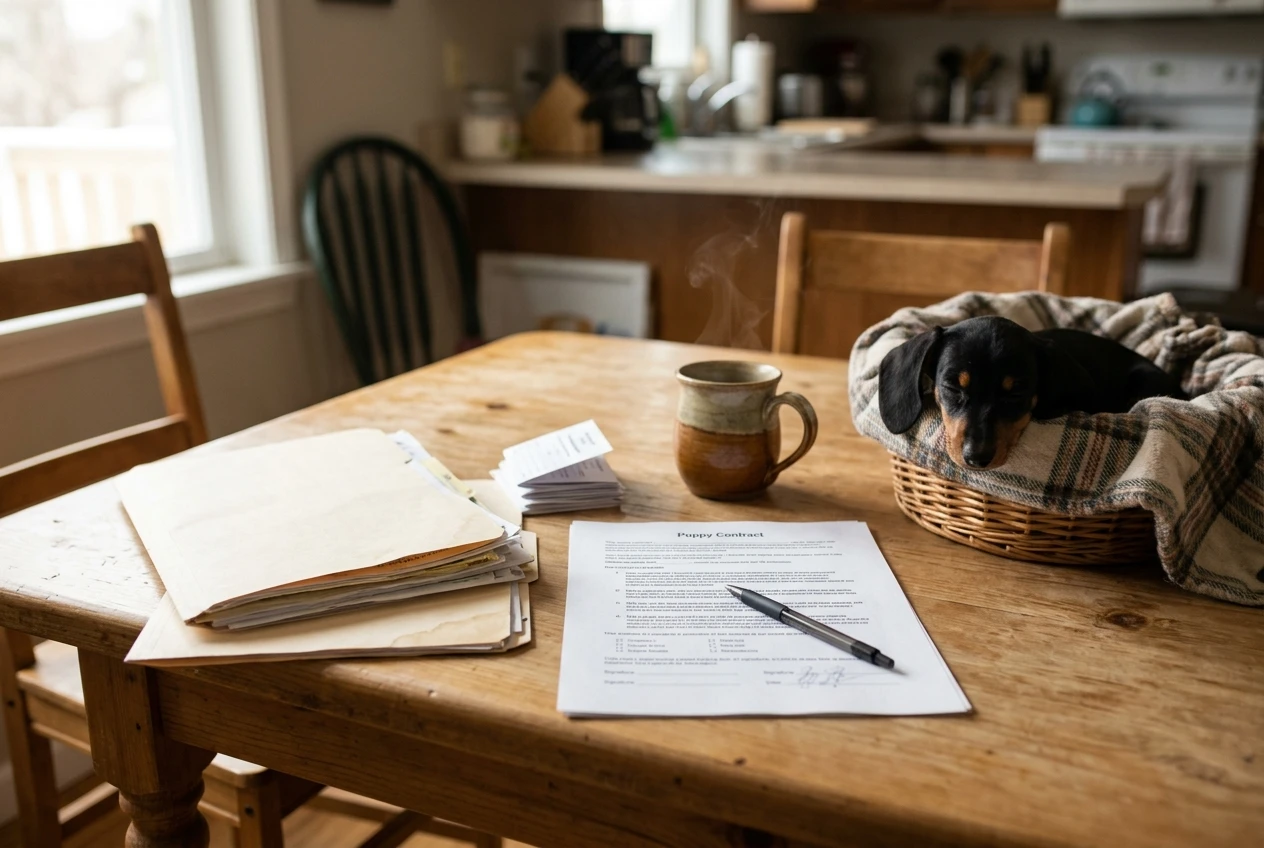
A kitchen table with a printed puppy contract, a pen, a folder of vet records and a small stack of vaccination cards, a coffee mug beside them, and a sleepy Dachshund puppy in a basket at the edge of the table in soft morning light.

The contract

Ask to read the contract before you pay anything. A good contract states the puppy’s details, the price, what is included, the health guarantee and its limits, spay/neuter or breeding terms, and what happens if you cannot keep the dog. Read it carefully, ask what any unclear terms mean, and be wary of a breeder who will not let you take it home to think.

The take-back policy

A responsible breeder will take back a puppy or dog at any point in its life if you cannot keep it. Look for that promise in writing. It tells you the breeder considers the dog their responsibility for life.

Deposits

A deposit is normal and reserves your place on the waitlist or a puppy from a litter. Before you pay, get answers in writing to these questions:

  • What is the deposit amount and what does it go toward?
  • Is it refundable, and under what conditions? For example, what happens if the litter is smaller than expected or no puppy matches your preferences?
  • How do I pay, and will I receive a receipt?

Pay by a method that leaves a record, and avoid gift cards and wire transfers.

Support after you bring the puppy home

The first days are when most families have questions: feeding, sleeping, crate training and the first vet visit. Ask whether the breeder is available for questions after the sale and how to reach them. Our walkthrough of your Dachshund puppy’s first seven days at home can help you plan, and a good breeder will gladly answer what comes up.

A One-Page Checklist to Screenshot

Save this to your phone and bring it to your first call or visit.

Before you call

  • Website or ad shows real dogs, named parents and a real location
  • Photos are not stock or copied from elsewhere
  • Breeder works with a small number of varieties

Walk away if

  • Puppies are always available, or many litters at once
  • No visit or video call is offered, or they want to meet in a parking lot
  • You are pressured to pay quickly, or asked for gift cards or wire transfers
  • No named parents, no health testing, no contract
  • Puppies leave before eight weeks
  • The mother is hidden, or the dogs and space look dirty or neglected

Green lights

  • A waitlist and a clear process
  • The breeder asks you questions about your home
  • You can see where the dogs live
  • They are honest about downsides and about back health

Ask on the call

  • Who are the parents, and how old is the mother?
  • Which health tests were done, and can I see the results?
  • How are the puppies raised and socialized?
  • When do they go home, and what vet care will they have had?
  • What is your take-back policy?
  • Can I speak to families who have your puppies?

Ask to see

  • Parents’ test results and registration
  • Puppy vet records, vaccines, deworming and microchip details
  • A written contract before paying a deposit
  • A written receipt for any deposit

At the visit

  • Mother present, healthy and calm
  • Clean, warm space with household contact
  • Puppies alert, plump and curious
  • Breeder patient and open with answers

Meet Us and Ask These Questions Yourself

We would like you to ask us everything on this list. You can read about our approach to breeding on our About Us page, then reach out about the next litter and our waitlist. Ask us the same questions you would ask any breeder and see how we answer them.

How to Groom a Dachshund at Home: Brushing, Baths, Nails, Ears and Teeth

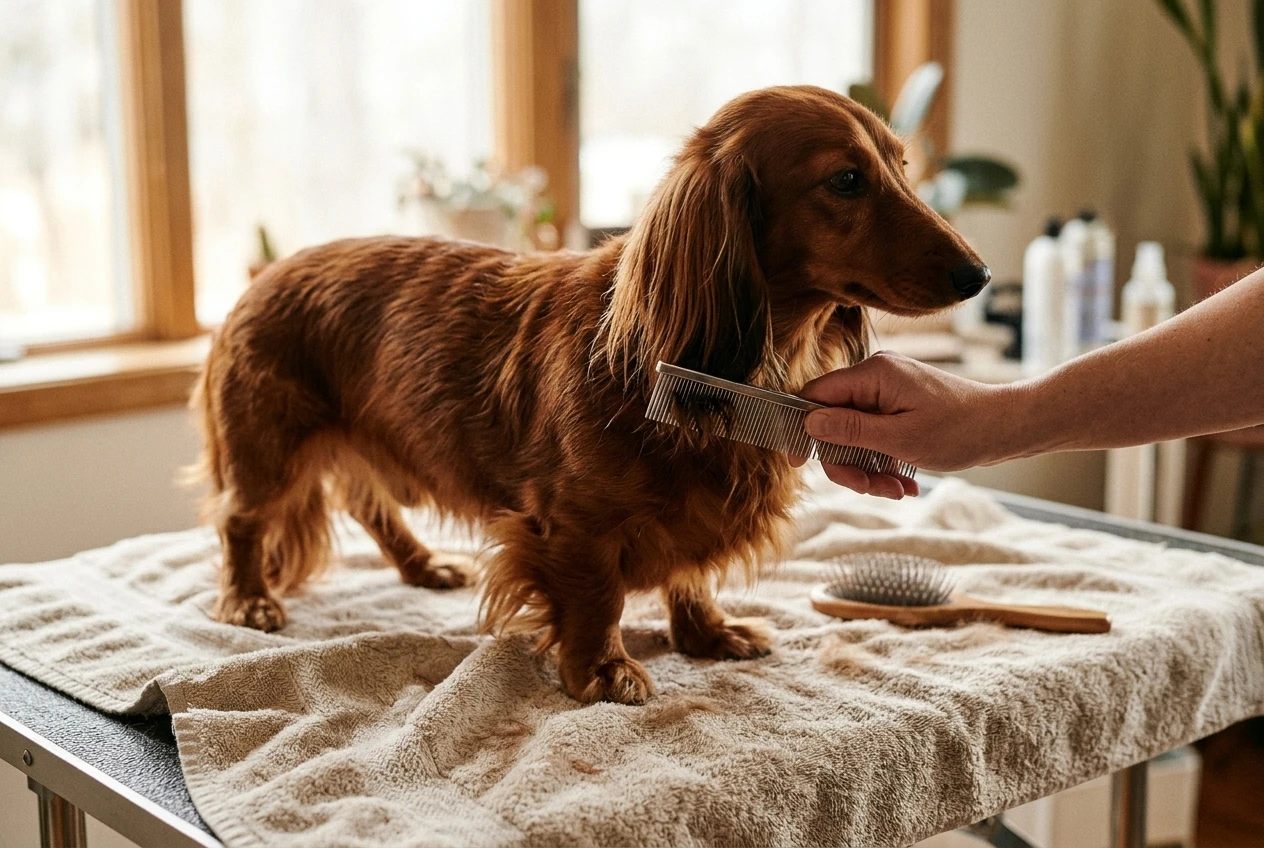
A longhaired dachshund standing on a towel-covered table while a hand works a steel comb through the silky feathering on its ear and chest, a pin brush beside it, soft window light a

Grooming a dachshund at home takes a few basic tools and about fifteen minutes a week once the dog is used to it. The details depend on the coat, and the habits you build in the first weeks decide whether the dog tolerates handling or enjoys it. This guide covers each task in the order most owners meet them.

Why a dachshund’s coat type changes your grooming routine

Dachshunds come in three coats, and each needs different care.

  • Smooth: a short, dense coat that sheds lightly all year. It needs the least brushing.
  • Longhaired: silky feathering on the ears, chest, belly, legs and tail. It tangles where the hair is longest and where it rubs.
  • Wirehaired: a harsh outer coat over a softer undercoat, with eyebrows and a beard. It needs occasional coat maintenance to stay tidy.

Nails, ears, teeth and baths are the same for all three. Brushing and coat upkeep are where they differ, so check which coat your dog has before buying tools.

The basic tool kit: what to buy and what to skip

Buy these:

  • A rubber curry mitt or soft bristle brush for smooth coats
  • A pin brush and a stainless steel comb for longhaired coats
  • A slicker brush and a comb for wirehaired coats
  • Nail clippers sized for small dogs, or a rotary nail grinder
  • Styptic powder, in case you cut a nail too short
  • Dog toothpaste and a finger brush or small soft toothbrush
  • Cotton balls or gauze and a vet-approved ear cleaner
  • A gentle dog shampoo, a rubber bath mat and a few towels

Skip human shampoo, human toothpaste and cotton swabs for ears. Human shampoo is formulated for a different skin pH. Many human toothpastes contain ingredients dogs should not swallow, and swabs can push debris deeper into the ear canal. Skip deshedding tools with sharp blades too, because they are unnecessary on a coat this short and can damage it.

Brushing smooth, longhaired and wirehaired coats

Smooth coats. Go over the body once a week with a curry mitt, moving in the direction the hair grows. This lifts loose hair and spreads skin oils through the coat. During heavier shedding periods, do it more often.

Longhaired coats. Brush two to three times a week, and check the feathering every day or two if the coat is thick. Work in sections with the pin brush, then run the comb through to confirm no tangles remain. The most common mats form behind the ears, under the collar, in the armpits and on the trousers at the back of the legs. Work a small mat apart with your fingers and the comb’s end teeth before brushing. Do not pull it straight through.

Wirehaired coats. A weekly pass with a slicker brush and comb keeps the coat clean and removes dead hair. Wirehaired coats are traditionally maintained by hand-stripping, which means plucking dead outer hair by hand a couple of times a year. Clipping softens the texture and changes the color over time. Many owners book a groomer who knows the breed for stripping and handle the weekly brushing and face tidying at home.

A longhaired dachshund standing on a towel-covered table while a hand works a steel comb through the silky feathering on its ear and chest, a pin brush beside it, soft window light and warm reddish-brown tones.

Bath time: how often, what to use and how to keep it calm

Most dachshunds do well with a bath every four to eight weeks, or sooner if they roll in something. Washing too often strips the natural oils and dries the skin, especially on smooth coats.

Put a rubber mat in the tub or sink so the dog’s feet grip, and fill it with a few inches of lukewarm water. Wet the coat from the neck back, lather with dog shampoo, and keep water and soap out of the ears and eyes. Rinse longer than seems necessary, because leftover shampoo irritates skin.

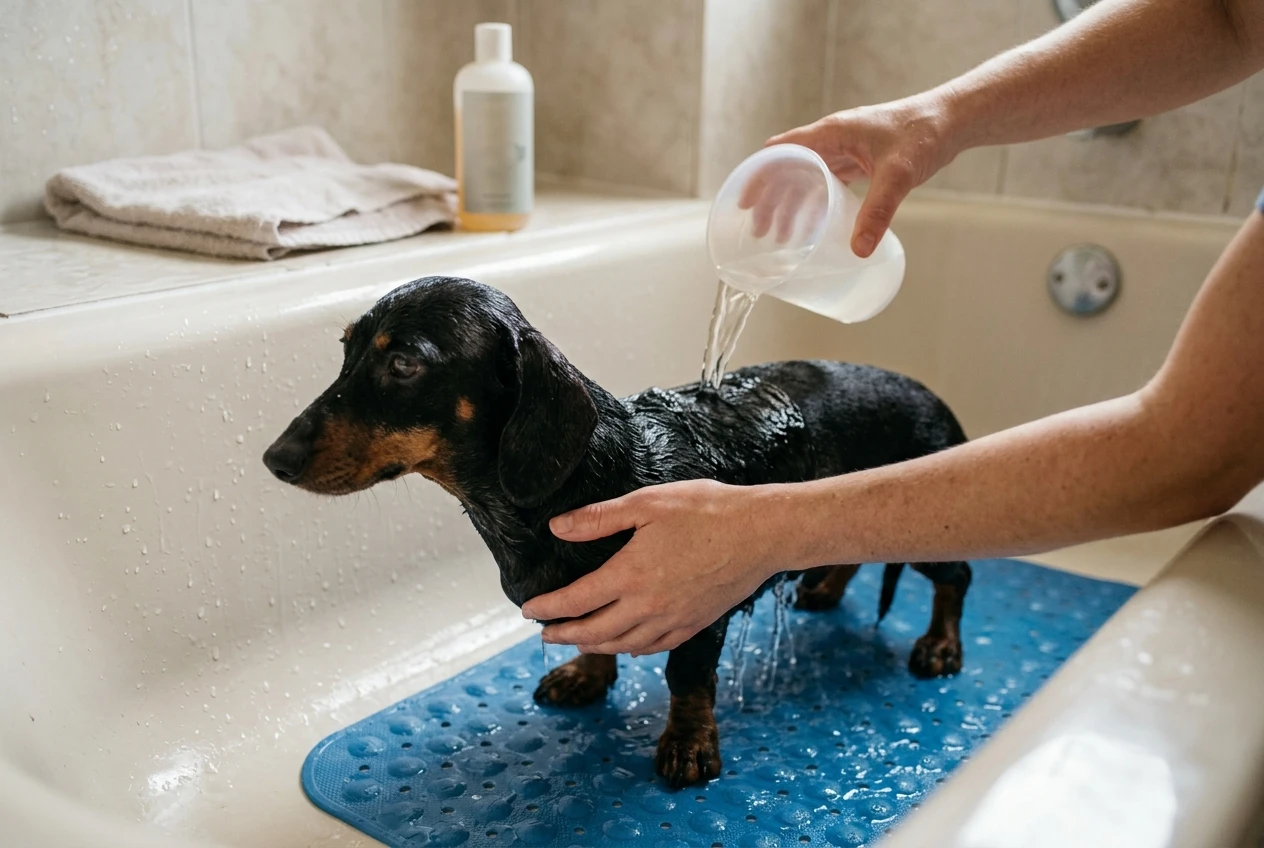
A wet smooth-coated dachshund standing on a blue rubber mat in a shallow bathtub, one hand supporting its chest and another hand pouring lukewarm water from a plastic cup, a folded towel and bottle of shampoo on the tub edge.

Towel dry thoroughly. Longhaired dogs need to be brushed while the coat is damp and again once it is dry, otherwise tangles set. Keep treats nearby and talk in a low, even voice. A dachshund that is lifted into the tub carefully, with one hand under the chest and one supporting the hindquarters, feels secure. Never let one leap out of the tub, since jumping down is hard on that long spine.

Trimming nails without a fight (and why short nails matter for a long-backed dog)

Long nails push the toes up and change how the foot meets the ground. On a dog built long and low, that affects posture and how the dog walks, and it adds to the strain on the legs and back. Our post on daily habits that reduce disc risk covers the wider picture. Short nails are one small part of it.

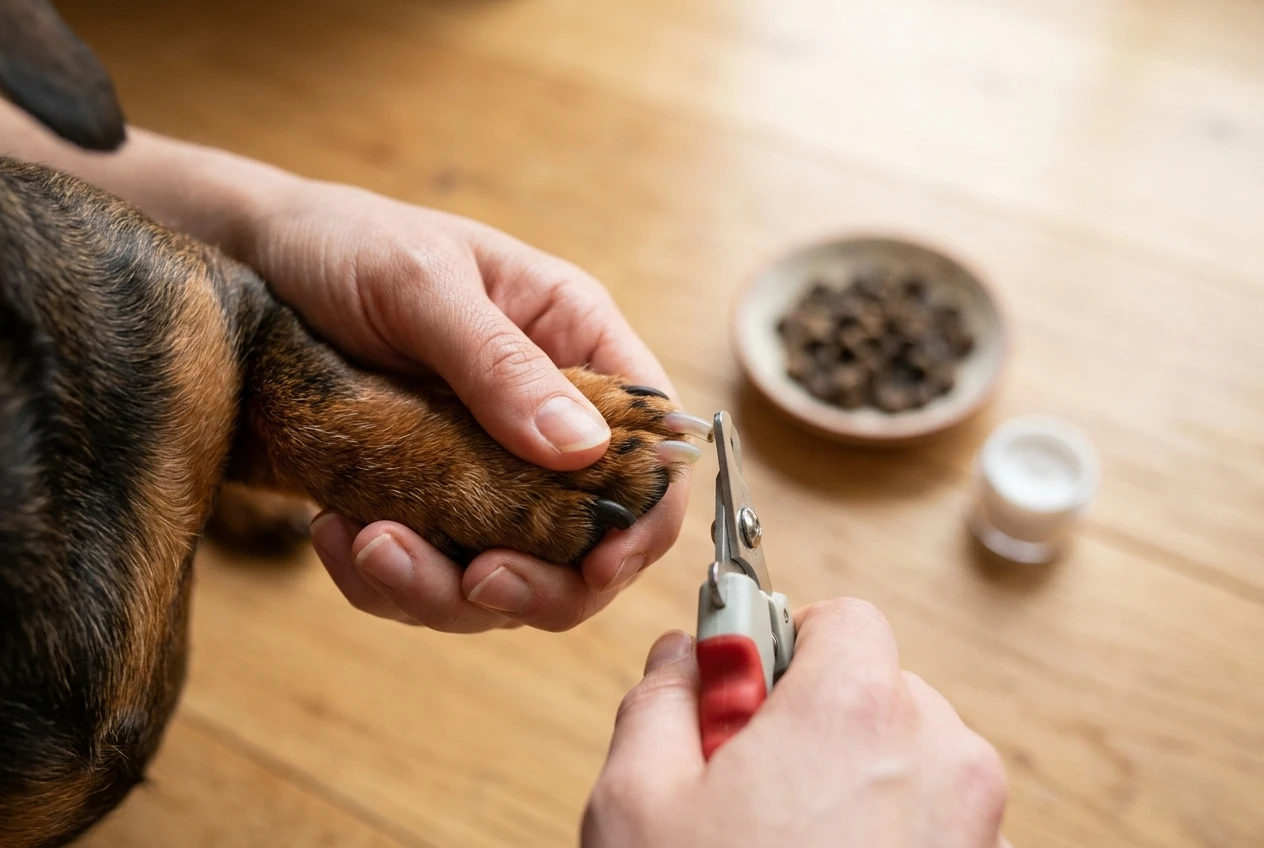
Trim every two to four weeks. If you hear nails clicking on a hard floor, they are due. Hold the paw firmly but gently, and clip a little at a time at a slight angle. On light nails you can see the pink quick inside. On dark nails, take off very small slivers and stop when you see a dark dot in the center of the cut end.

Close-up of a dachshund's front paw held gently in a hand, small nail clippers positioned at the tip of a pale nail with the pink quick visible, a dish of treats and a jar of styptic powder blurred nearby on a wooden floor.

If you hit the quick, press styptic powder on the tip and stay calm. The dog will pick up on your reaction. A grinder works well for nervous dogs because it removes nail in tiny amounts, but the dog needs to be introduced to the sound first. Run it near the dog while giving treats before it ever touches a nail.

Ear cleaning and checking for trouble signs

Longhaired dachshunds in particular have ears that hang close to the head, which reduces airflow. Check the ears weekly for dirt, odor and redness.

To clean, squeeze a vet-approved ear cleaner into the canal, massage the base of the ear for a few seconds, then let the dog shake. Wipe the visible part of the ear with a cotton ball or gauze. Stop at the point you can see. Do not push anything deeper.

Contact your vet if you notice any of these:

  • A strong or sour smell
  • Dark, waxy or yellow discharge
  • Redness or swelling inside the ear
  • Frequent head shaking or scratching at one ear
  • Pain when you touch the ear

Ear infections need diagnosis and treatment. Cleaning alone will not clear one.

Teeth, paws and the places owners forget

Small breeds are prone to dental disease, so teeth need regular attention. Brush with dog toothpaste daily if you can, and at least several times a week. Start by letting the dog lick the paste from your finger, then move to a finger brush, then a small toothbrush. Concentrate on the outer surfaces of the back teeth, where tartar builds up first.

Other places to check each week:

  • Paw pads and between the toes: look for cuts, burrs and irritation. Trim long hair between the pads on longhaired dogs so it does not collect debris.
  • Eyes: wipe away crust at the corners with a damp cloth.
  • Skin under the tail, in the armpits and along the belly: look for redness, lumps or parasites.
  • Anal glands: if the dog scoots along the floor, ask a vet or groomer to check. Do not squeeze them yourself unless a professional has shown you how.

Teaching a puppy to enjoy being handled

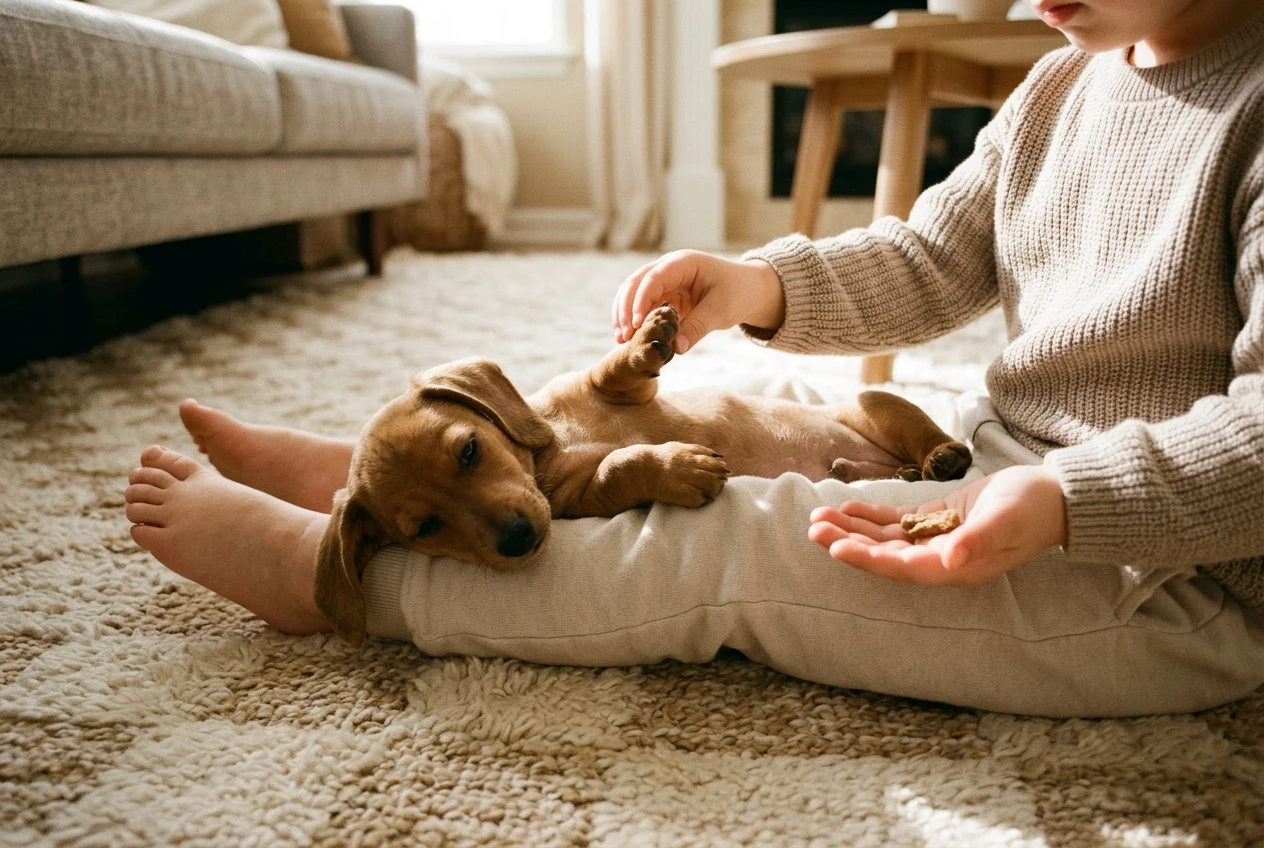
Grooming goes best when handling already feels normal. From the first weeks, touch the puppy’s paws, ears, mouth, tail and belly in short, calm sessions, and follow each one with a treat or a quiet cuddle. Keep sessions to a minute or two and stop while the puppy is still relaxed.

A young dachshund puppy relaxed on a child's lap on a living room rug, the child gently holding one tiny paw while a treat sits in their other hand, soft afternoon light and cozy cream and tan tones.

Introduce each tool on its own. Let the puppy sniff the brush, then stroke once, then reward. Do the same with clippers, touching the closed clippers to a toe without clipping. Do a pretend nail trim a few days before the first real one.

If you are bringing a puppy home, our first seven days at home guide shows where handling practice fits alongside feeding, sleeping and house training. Short, regular, happy sessions work better than one long one. A puppy that has been rewarded for being touched usually grows into an adult that stands still for the groomer and the vet.

A simple weekly and monthly grooming schedule

Daily

  • Brush teeth if possible
  • Quick check of longhaired feathering

Weekly

  • Brush the coat (more often for longhaired dogs)
  • Check and wipe ears
  • Look over paws, eyes and skin
  • Brush teeth if you do not do it daily

Every two to four weeks

  • Trim or grind nails
  • Tidy hair between the paw pads

Every four to eight weeks

  • Bath, depending on activity and coat

Twice a year, or as your groomer advises

  • Hand-strip a wirehaired coat

Once a year at least

  • Veterinary exam, including teeth and ears

When to book a professional groomer or call the vet

A groomer is the right call for hand-stripping a wirehaired coat, for severe matting on a longhaired dog, and for nails if you or the dog cannot manage them yet. Ask whether the groomer has handled dachshunds before, and ask them to be careful lifting and positioning the dog so the back is supported.

Call the vet for ear infections, bad breath that does not improve with brushing, loose or broken teeth, bleeding gums, persistent scratching, hair loss, lumps, limping, and any sign of pain when you touch the back or neck. Back pain in a dachshund should always be treated as urgent.

If you’re thinking about welcoming a dachshund puppy into your home, take a look at our available litters and get in touch with us about joining the waiting list.

How to Protect Your Dachshund’s Back: Daily Habits That Reduce Disc Risk

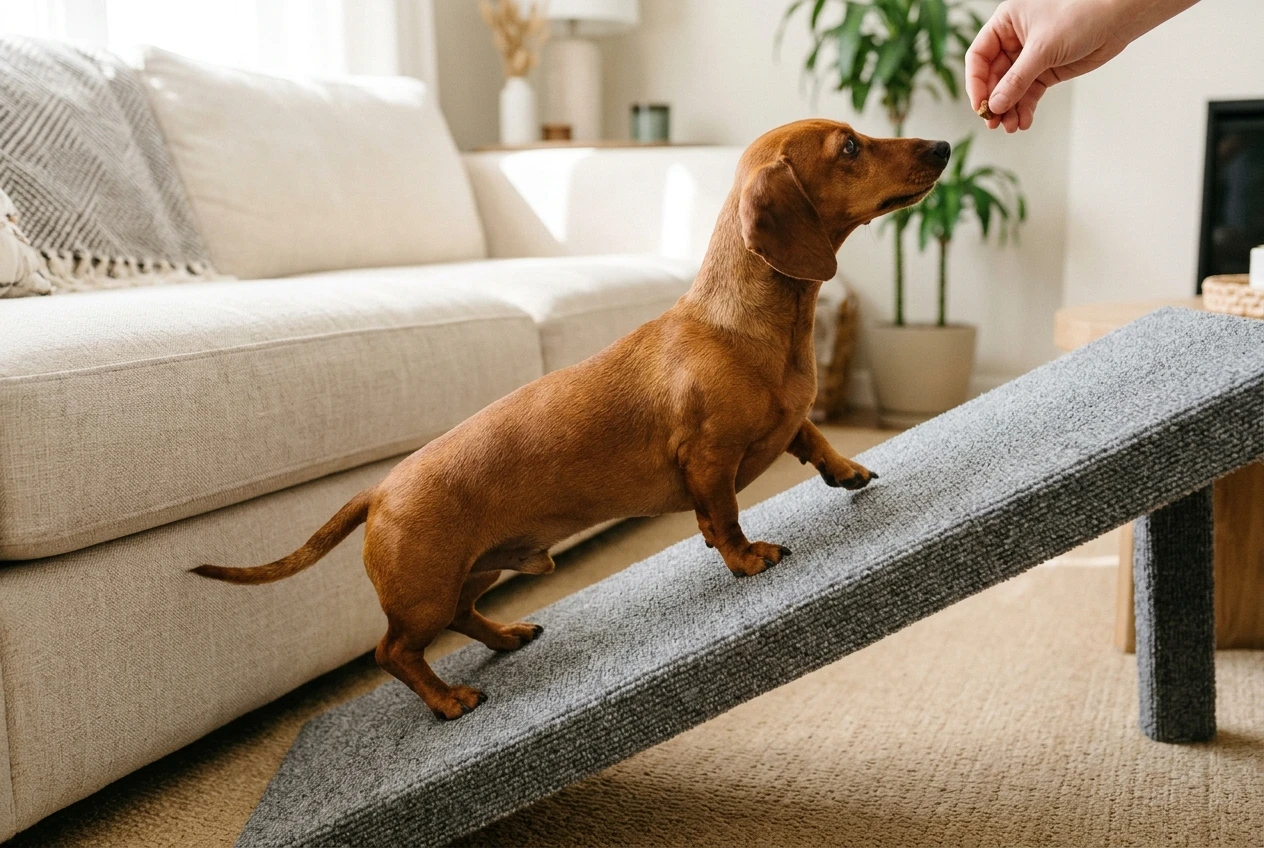
A red smooth-coated dachshund walking up a gently sloped, carpet-textured pet ramp beside a cream fabric sofa in a bright living room, a treat held just ahead of its nose by a hand a

Dachshunds were bred with a long body and short legs, and that shape puts more mechanical load on the spine than the build of most other dogs. The same genetics that give a dachshund its look also make the cushioning discs between the vertebrae wear out earlier. You cannot change that. You can change how much daily strain those discs take, and that is the practical side of how to prevent back problems in dachshunds.

This guide covers the routine: stairs, furniture, lifting, weight, harnesses, play, and the early signs that something is wrong. None of it replaces your vet, but nearly all of it costs nothing and takes a few seconds a day.

Why a dachshund’s long back needs different care from other breeds

Between each pair of vertebrae sits a disc, a tough outer ring around a softer center. In dachshunds, the discs tend to lose moisture and harden at a young age, sometimes well before the dog is middle-aged. A hardened disc absorbs shock poorly. A jump off a sofa, a awkward twist, or a hard landing can push disc material toward the spinal cord. That is intervertebral disc disease, usually shortened to IVDD, and it is the main back problem in the breed.

Two things follow from this. First, the risk exists whether or not your dog has ever shown a symptom, so prevention starts the day a puppy comes home. Second, the damage often builds up from many small stresses and then shows itself after one ordinary movement. Owners often say the dog “just jumped off the couch like always.” The couch was not the whole cause, but it was the last of many impacts.

Most of what follows comes down to three goals: fewer impacts, a lean body, and a spine that stays supported when you handle or restrain the dog.

Stairs, sofas and beds: how to stop the jumping without stopping the fun

Dachshunds are athletic and bold, and they will launch off any surface they can reach. Telling a dachshund not to jump does not work, so change the environment instead.

A red smooth-coated dachshund walking up a gently sloped, carpet-textured pet ramp beside a cream fabric sofa in a bright living room, a treat held just ahead of its nose by a hand at the edge of the frame.
  • Ramps and pet steps for furniture. Put a ramp or a set of sturdy steps beside the sofa and the bed. Choose a ramp with a textured, non-slip surface and a gentle slope. A short, steep ramp is hard on the dog’s back too.
  • Teach the ramp with treats. Lure your dog up and down a few times a day for a week or two. Most dachshunds adopt it quickly once it is the easiest route to your lap.
  • Block access when you cannot supervise. Close the bedroom door, use a baby gate, or put the dog in a pen. A dog that cannot reach the bed cannot jump off it.
  • Carry on stairs when practical. Full flights of stairs, especially going down, put repeated jarring on the spine. If your home has stairs you use constantly, a gate at the top and bottom for puppies and carrying a small adult is reasonable. Older dogs and dogs with a back history deserve extra caution.
  • Teach a “wait” at doors, car edges and sofa edges. A dachshund that pauses before leaping gives you time to lift it down.

Floors matter as well. A dachshund that scrambles on tile or hardwood twists its back to catch itself. Put runners or non-slip mats on the routes your dog uses most, and keep the nails trimmed so the toes grip. Long hair between the paw pads can also cause slipping, so ask your groomer or vet to show you how to trim it.

Fun does not have to stop. Move the jumping games to the floor, where chasing, sniffing, and hide-and-seek keep the dog busy at ground level.

The right way to pick up and carry a dachshund

Every dachshund gets picked up, so how you do it counts. The aim is to keep the spine level and supported, with no dangling and no twisting.

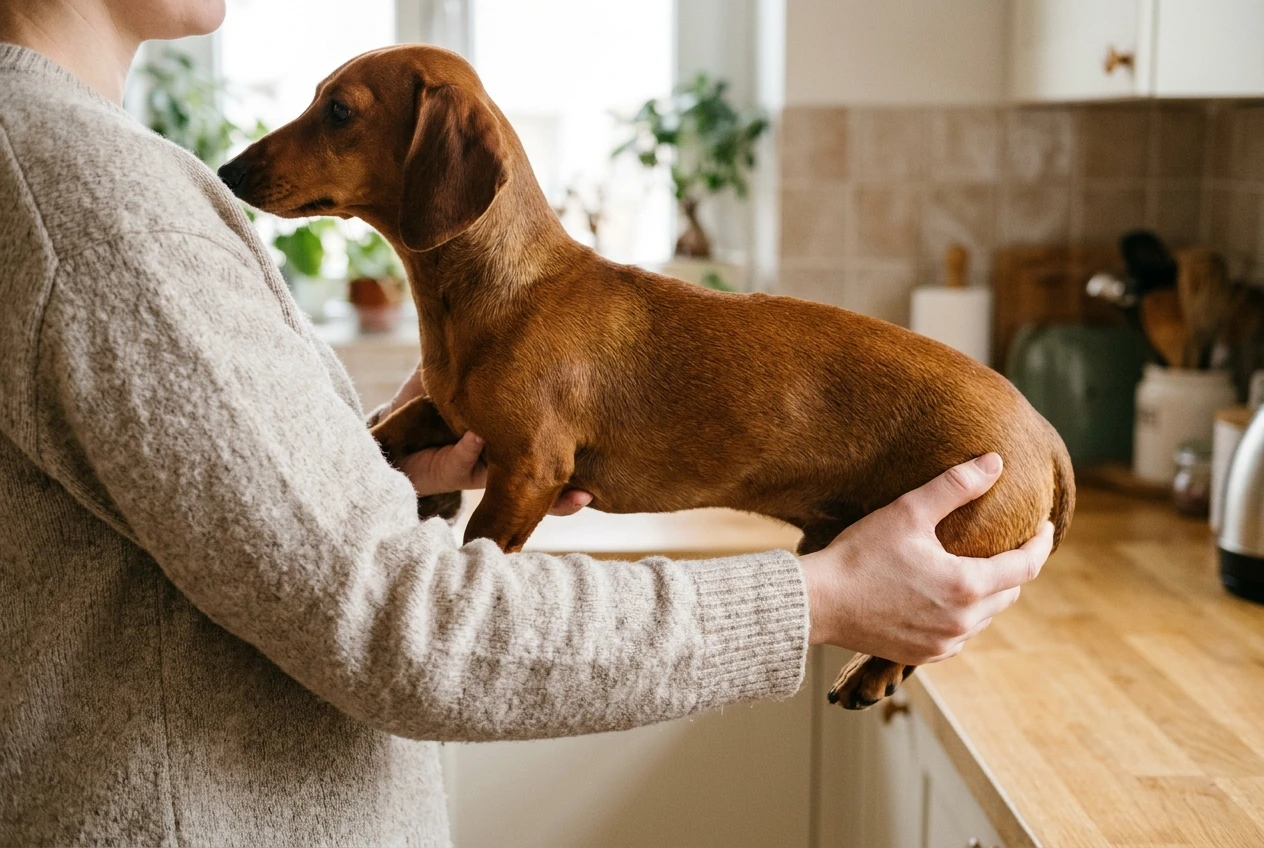
Close view of a person's hands lifting a dachshund correctly: one forearm under the chest between the front legs, the other hand cradling the hindquarters, the dog's long back held level. Soft window light in a tidy kitchen, warm wood tones.
  1. Approach the dog calmly and let it see you, so it does not wriggle suddenly.
  2. Slide one hand under the chest, between the front legs, with your forearm along the belly.
  3. Place the other hand under the hindquarters, supporting the rear legs and bottom.
  4. Lift so the back stays horizontal, then bring the dog in against your body.
  5. Lower the dog the same way, letting all four feet touch the ground together.

Avoid lifting by the front legs, scooping under the armpits alone so the back end hangs, or holding the dog upright like a baby with the hindquarters dropping. Ask children to sit on the floor and have the dog placed in their lap rather than carry it. Small children should not carry a dachshund at all, because a squirming dog is easy to drop, and a fall is dangerous for that spine.

Teach every person in the household, and visitors who want to cuddle the puppy, to use the two-handed hold. It takes about a minute to demonstrate.

Weight and diet: why extra pounds land on the spine

Every extra pound a dachshund carries pulls on the same long, unsupported spine. Excess weight also reduces the muscle tone along the belly and back that helps stabilize the vertebrae. A lean dachshund is easier on its discs than an overweight one, and it is a factor you control entirely.

Check your dog’s body condition regularly:

  • You should be able to feel the ribs under a thin layer of padding without pressing hard.
  • Looking from above, you should see a visible waist behind the ribs.
  • From the side, the belly should tuck up slightly instead of hanging level or sagging.

If you cannot find the ribs or the waist, talk to your vet about a target weight and a feeding plan. Measure meals with a scale or a measuring cup instead of guessing, count treats as part of the daily food, and keep table scraps out of the picture. Dachshunds are experts at looking hungry. A dog that begs is not necessarily a dog that is underfed.

What goes into the bowl matters too. Our page on what we feed our dogs covers feeding in detail, so there is no need to repeat it here. The principle for the spine is simple: feed a quality diet in measured amounts and adjust portions to the dog’s body condition, not to its pleading.

Harness, leash and play: what protects the neck and back, and what to avoid

A collar concentrates every pull on the neck, and a dachshund that lunges at a squirrel can strain the cervical spine. The neck has discs too. For daily walks, a well-fitted harness spreads the force across the chest instead.

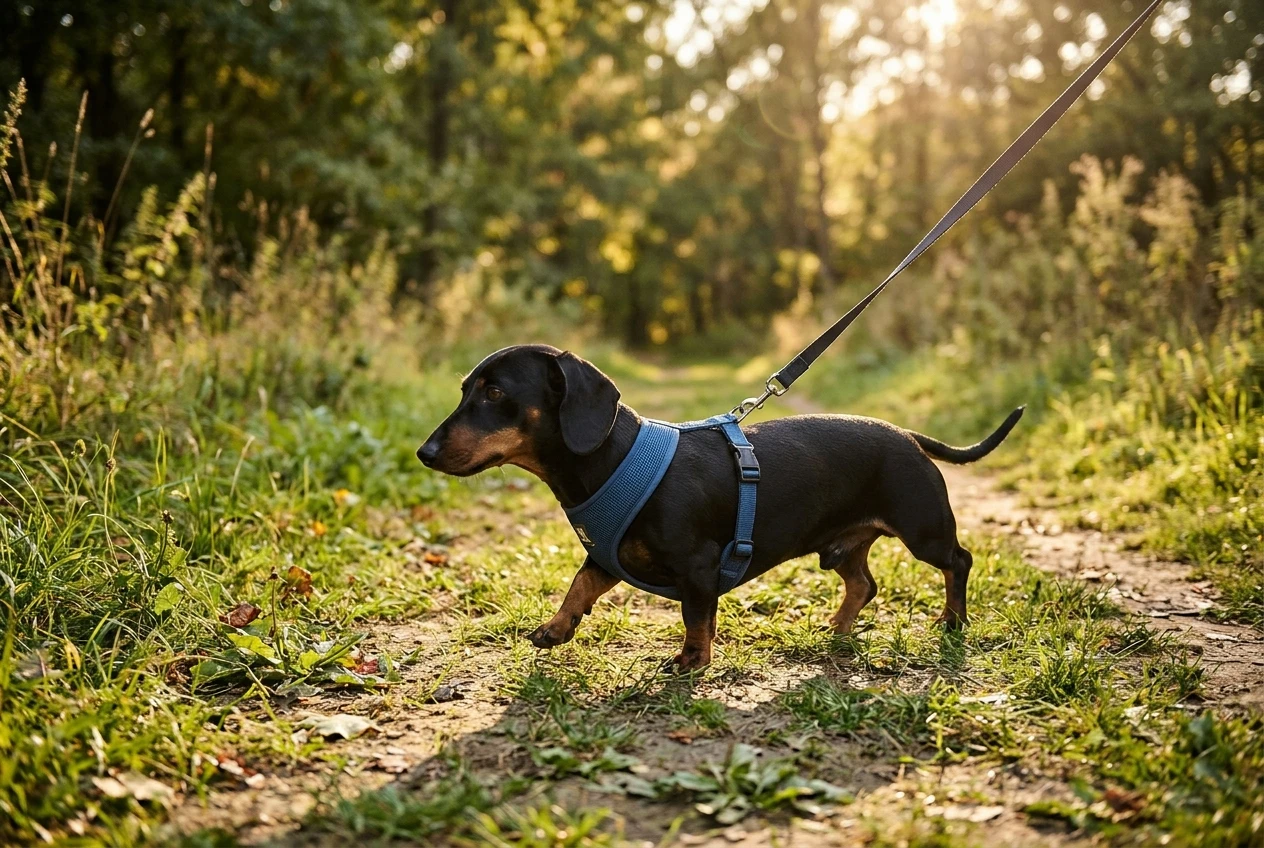
A black-and-tan dachshund walking on a grassy path in a well-fitted blue chest harness attached to a plain fixed-length leash, the strap sitting behind the front legs, with golden late-afternoon light and trees behind.

What to look for in a harness:

  • It sits across the chest and behind the front legs without pressing on the throat.
  • It fits snugly enough that the dog cannot back out, but you can slide two fingers underneath.
  • It does not squeeze the ribs or restrict the shoulders as the dog walks.
  • It is sized for a long, narrow body. Many harnesses are designed for rounder breeds and fit dachshunds badly, so check the fit on your actual dog.

Choose a standard fixed-length leash over a retractable one. A retractable leash lets the dog hit the end at speed and then stops it abruptly, which jerks the body. Train loose-leash walking so the dog is not hauling on the harness either.

Play deserves the same attention:

  • Avoid games that make the dog jump for a toy or leap in the air to catch a ball.
  • Skip tug-of-war that lifts the dog’s front end off the floor or involves hard twisting.
  • Be careful around much larger dogs. A friendly body slam from a big playmate can injure a dachshund.
  • Do not encourage begging on the hind legs. Sitting up on the back legs puts the spine in an unnatural curve.

Do keep exercise up. Regular walks on level ground build the muscle that supports the spine. Moderate, steady exercise is better than occasional bursts of intense running, and young puppies should not be pushed on long or strenuous walks while their bones and joints are still developing. Ask your vet how much exercise suits your dog’s age.

Puppy-proofing the home for a growing spine

A puppy needs a home where the safe choice is also the easy one. Before the puppy arrives, walk through each room and ask where the dog could climb up, jump down, or slip.

Set up these basics:

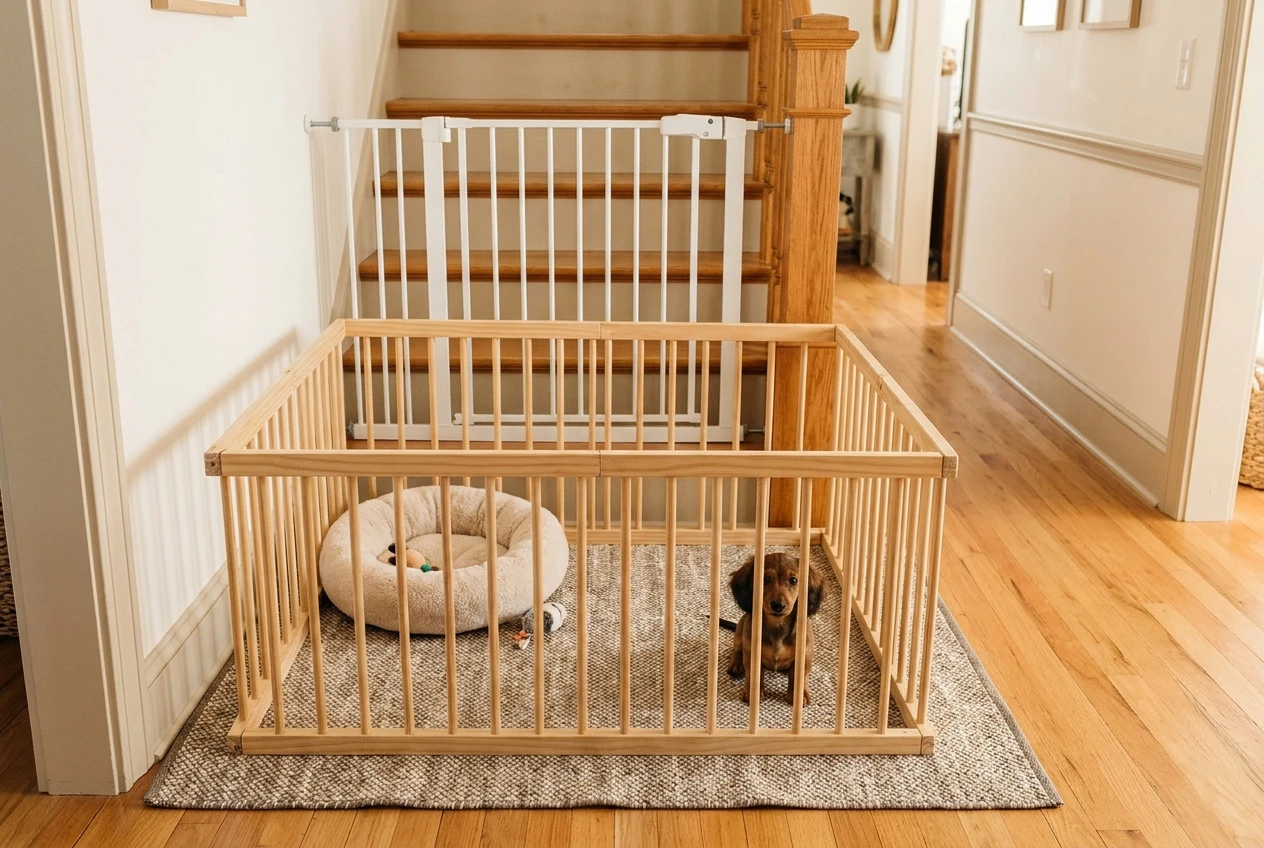
A dachshund puppy sitting inside a wooden playpen on a non-slip rug, with a white baby gate across the foot of a staircase behind it and a low, soft bed in the corner, in a calm hallway with morning light.
  • Baby gates at the top and bottom of staircases.
  • A ramp or step beside the sofa and bed, with the puppy introduced to it in the first days.
  • A playpen or a gated area with non-slip flooring for times you cannot watch.
  • Rugs or mats on slippery floors.
  • A low, stable crate or bed that does not need climbing into.
  • A rule that nobody carries the puppy except with the two-handed hold.

The arrival period is when habits form. Our guide to the first seven days at home with a dachshund puppy covers the daily schedule. Add the spine-protecting habits to that routine from day one, so the ramp, the gate, and the careful lift are simply how the household works. A puppy that has never been allowed to jump off the sofa does not miss it.

Early warning signs of back pain and when to call the vet right away

Dachshunds are stoic, and back pain is easy to miss. Watch for changes in behavior as well as obvious symptoms. Early signs can include:

  • Reluctance to jump, climb stairs, or go for walks it used to enjoy.
  • A hunched or tucked posture, with the head held low.
  • Trembling, panting, or restlessness without an obvious cause.
  • A yelp when picked up, touched along the back, or when moving.
  • Stiffness, a tense belly, or refusing to eat.
  • Unwillingness to turn the head, which can point to the neck.

Any of these is a reason to call your vet the same day. Mild pain can still signal a disc problem, and early treatment gives the best chance of avoiding a worse episode. Limit the dog’s activity while you wait, and do not give human painkillers. Medications such as ibuprofen and acetaminophen can be toxic to dogs. Only give what your vet prescribes.

Go to the vet or an emergency clinic immediately if you see:

  • Wobbling, dragging, or crossing of the back legs.
  • Knuckling over on the paws, so the dog walks on the tops of its feet.
  • Sudden inability to walk or stand.
  • Loss of control of the bladder or bowels.
  • Severe pain, crying out, or paralysis.

With disc injuries, speed matters. Hours can make a difference to recovery, so do not wait to see whether it improves overnight. Treatment depends on the severity and may involve strict rest, medication, or surgery, and that decision belongs to your vet.

What a breeder looks for in parent dogs to lower risk

Daily care lowers the strain on the spine, but genetics set the starting point. This is where a breeder’s choices count most. Responsible breeders pay attention to the parents’ structure, health history, and family lines before planning a litter.

Things worth looking for include:

  • Sound, balanced build. A body that is not excessively long, with legs in proportion and a level topline.
  • Healthy weight and fitness in the parents. Parents kept lean and in good muscle condition.
  • Back health history. Whether the parents, and their close relatives, have had disc problems, and at what age. Breeders who keep records of this can make better pairing decisions.
  • Screening where available. Some breeders use veterinary checks, such as spinal radiographs, to look at disc calcification in breeding dogs. Ask your breeder what they do and why.
  • Openness. A breeder who answers questions about the parents’ health and lets you see how the dogs live is a good sign.

No breeder can promise a dachshund will never have a back problem, and you should be wary of anyone who does. What a good breeder can do is reduce the odds through careful selection and then support you with advice on raising the puppy. For a fuller look at the standards behind healthy litters, read our article on what ethical dachshund breeding is and why it matters.

If you’re thinking about adding a dachshund puppy to your family, get in touch with us about upcoming litters and ask how we raise our puppies with spine health in mind.

What Living With a Dachshund Is Really Like: Stubborn, Loud, Loyal and Funny

A red smooth-coated dachshund standing at the mouth of an earthen burrow among tree roots in a misty autumn woodland, nose down and tail up, as soft golden morning light filters thr

Dachshunds have a reputation for being funny, loyal and difficult, and all three are accurate. The breed’s temperament comes from a specific job, and once you understand that job, most of the behavior that surprises new owners starts to make sense. This article describes what daily life with the breed looks like so you can decide whether it suits your household. No breeder can promise the personality of one particular puppy, and this article doesn’t try to.

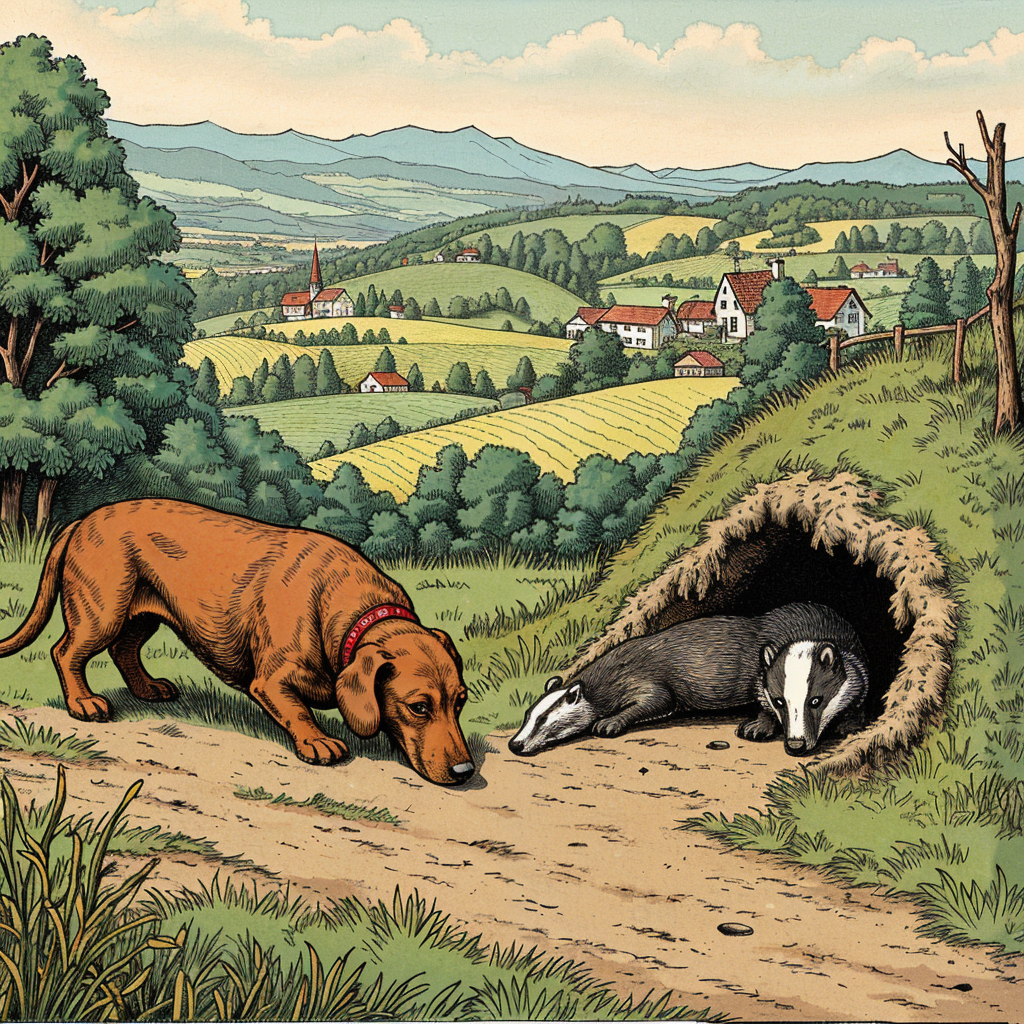
Bred to hunt badgers: where the dachshund personality comes from

The name is German for “badger dog.” Dachshunds were developed to follow a scent, go underground into a burrow, and confront an animal that could fight back. That work needed a dog that would act on its own judgment, far from its handler, with nobody to give instructions once it was in the tunnel.

Each trait that frustrates owners today matches a need of that job. A dog that waits for approval before every decision would have been useless underground. A quiet dog could not tell hunters where it was. A dog that lost interest after a few minutes of digging would never have reached the badger. The long body, short legs, big chest and surprisingly deep bark were all selected for burrow work.

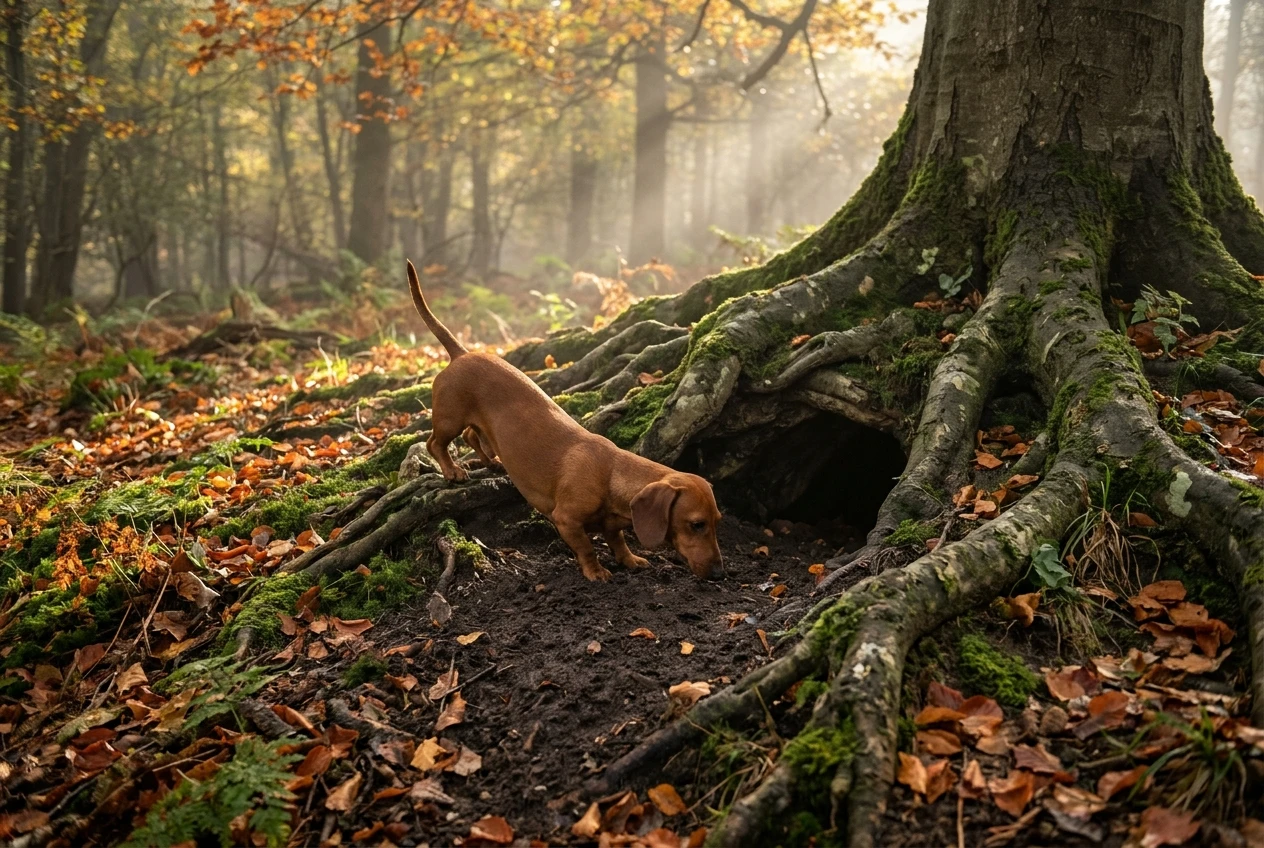
A red smooth-coated dachshund standing at the mouth of an earthen burrow among tree roots in a misty autumn woodland, nose down and tail up, as soft golden morning light filters through the leaves.

Plenty of dachshunds today have never seen a badger, but the instincts are inherited. They show up in the living room as a dog with strong opinions, a loud voice and a nose that overrides most other things.

The stubborn streak: what it looks like at home and how to work with it

Stubbornness in a dachshund rarely looks like defiance. It looks like a dog that heard you, understood you and is weighing whether your request is worth it. You call from the back door and the dog keeps sniffing the same square foot of lawn. You ask for a sit and get a long look.

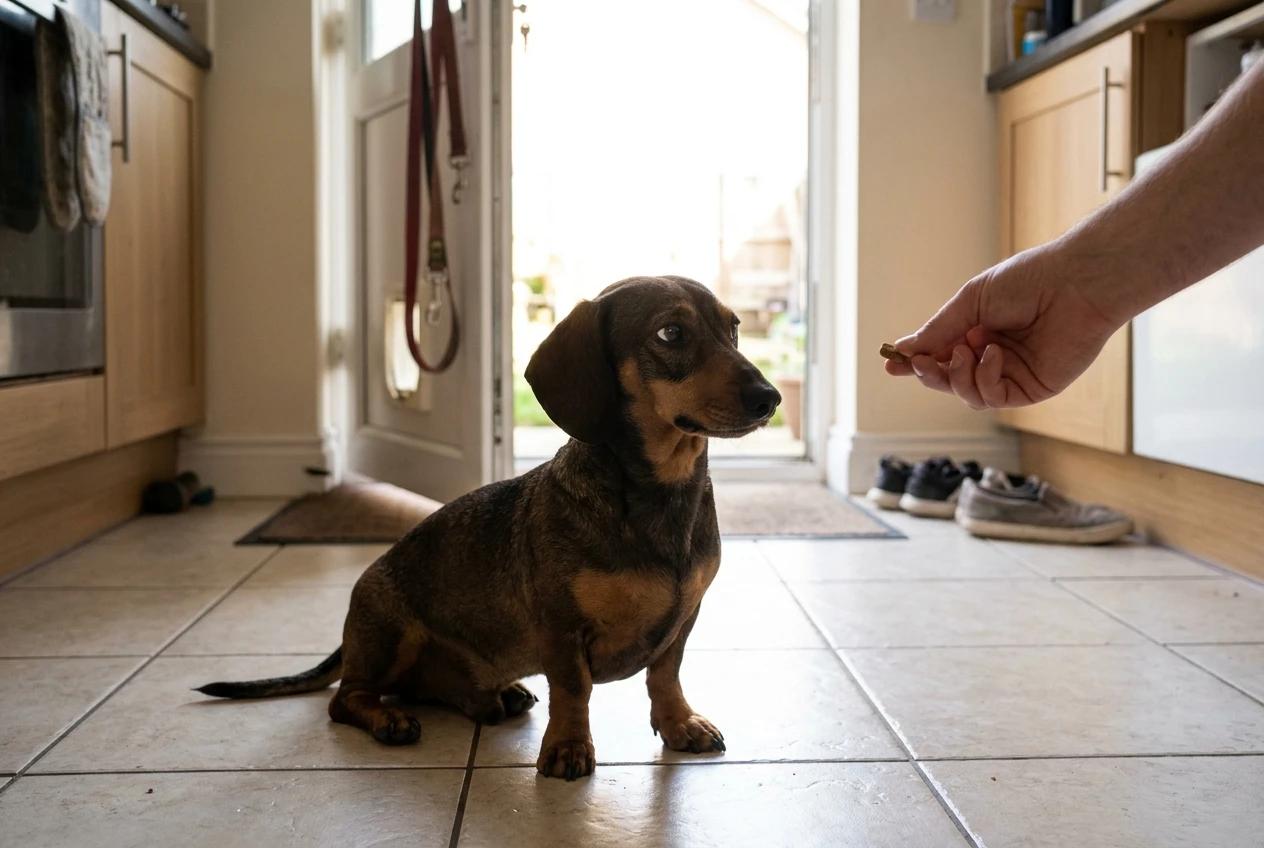
A dachshund sitting on a kitchen floor giving a long, unimpressed sideways look at a hand holding out a small treat, while a leash hangs from the open back door behind it and bright daylight spills onto the tiles.

Dachshunds are intelligent, which is part of the problem. They learn quickly, including the things you did not mean to teach. If whining at the table has worked twice, it is now a policy.

A few approaches hold up well with the breed:

  • Use food and play as pay. Praise alone is often not enough for a scent hound. Small, tasty rewards give the dog a reason to cooperate.
  • Keep sessions short. Five focused minutes, a few times a day, beat one long session that ends with a bored dog and an irritated owner.
  • Be consistent across the household. If one person allows the sofa and another does not, the dog will pick the more permissive person every time.
  • Skip harsh corrections. Dachshunds tend to shut down or dig in when pushed. Calm repetition works better than escalation.

House training deserves a special mention. Many owners find dachshunds slower to housebreak than other small breeds, and a dog that dislikes cold, wet grass will argue about going outside in winter. A fixed schedule, a covered or sheltered potty spot and generous rewards for going in the right place make a real difference. The same patience applies to crate training and leash manners.

Barking, digging and chasing: the hound behaviors that surprise new owners

Dachshunds bark more than most people expect from a dog their size, and the bark is deeper than you would guess. They alert to the doorbell, the mail carrier, a squirrel, a leaf and a noise that only the dog heard. If you live in an apartment with thin walls or close neighbors, take this seriously before you buy.

Barking can be managed but rarely eliminated. Teaching a “quiet” cue, reducing the dog’s view of the street, and making sure it gets enough exercise and mental work all help. A bored dachshund barks more.

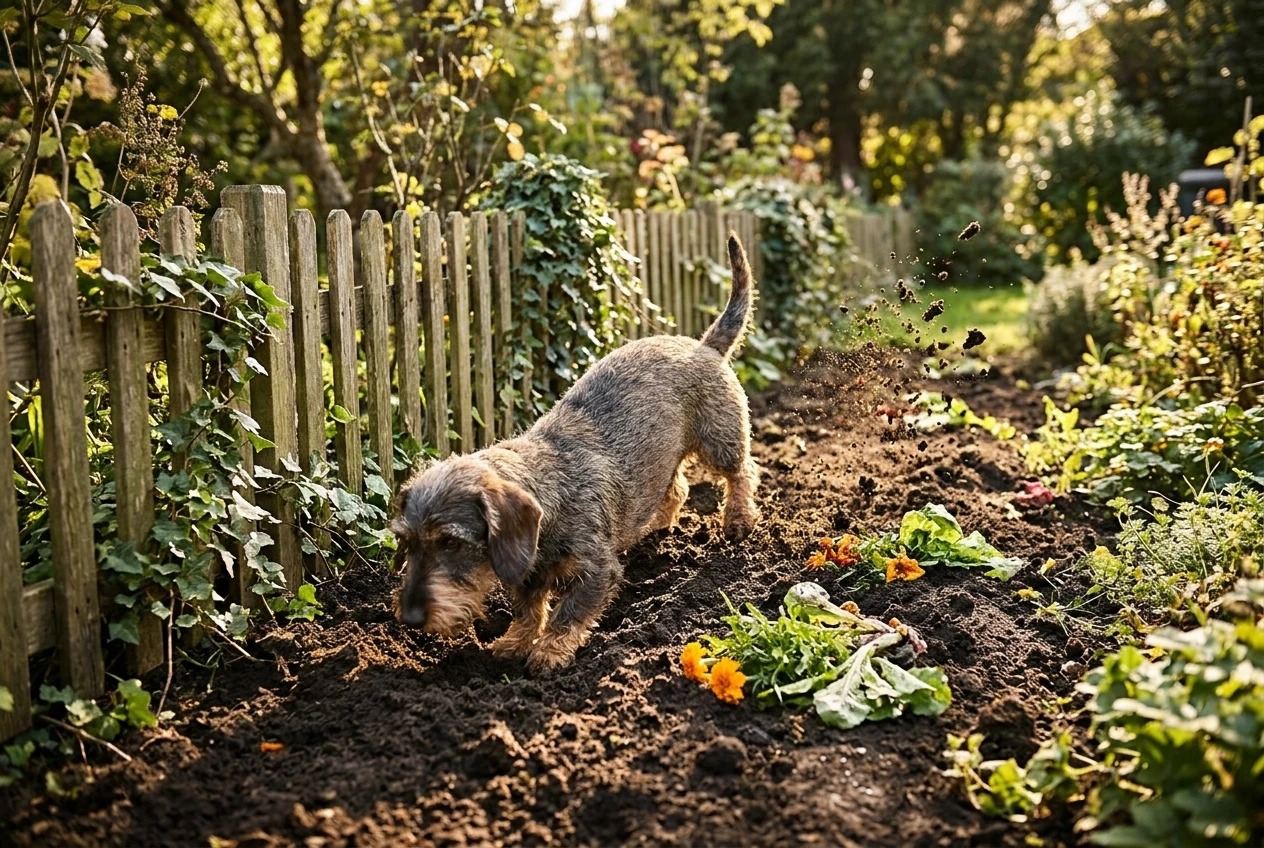
Digging is the second surprise. A dog bred to tunnel will dig in gardens, in couch cushions and in blankets. Some dachshunds burrow under covers at night, which many owners find endearing. If you have a garden you care about, plan on fencing off beds or giving the dog a designated digging spot.

A wirehaired dachshund mid-dig in a garden bed, soil flying, with a trail of upturned earth and a few flattened flowers behind it, beside a low wooden fence in warm afternoon sun.

Then there is chasing. The nose leads and the brain follows. A dachshund that catches a scent may ignore your recall entirely, and a small animal running across a yard can trigger a sprint. For safety, most dachshunds should be on a leash or in a securely fenced area. Fences should be checked at ground level, since a determined dachshund will find a gap or dig under.

One physical point affects behavior and owner choices alike: the long spine. Dachshunds are prone to back problems, so repeated jumping off furniture and climbing steep stairs are best limited. Ramps, steps and lifting the dog with support under the chest and hindquarters are common precautions. A dog that loves to leap off the sofa needs an owner who sets up the home to prevent it.

Velcro dogs: affection, attachment and why many dachshunds struggle alone

Dachshunds bond closely with their people, and many follow one person from room to room. They sit on laps, burrow into blankets next to you and sleep against your legs. For some households this is the best thing about the breed.

A longhaired dachshund curled tightly against a person's legs under a chunky knitted blanket on a sofa, only its nose and one ear poking out, in cozy lamplight with a mug on the side table.

The flip side is that many dachshunds do poorly when left alone for long stretches. A dog bred to work in partnership with hunters may react to isolation with barking, chewing, house soiling or general distress. Owners who work long hours away from home should think hard about this before bringing a puppy home.

If you are away during the day, there are workable options: a midday visitor or dog walker, a household where someone is usually home, or a second dog for company, though a second dog does not suit every household or every dog. Gradual alone-time training from the first weeks helps a puppy learn that being left is temporary. Our guide to the first week with a dachshund puppy covers how to begin that routine from day one.

Dachshunds with kids, cats and other dogs: what to expect and what to supervise

Children. Many dachshunds do well with respectful, gentle children. The breed is sturdy in spirit but fragile in the back, and a dog that is picked up wrongly, dropped or ridden like a pony can be badly hurt. Very young children should not carry a dachshund, and all interactions with small kids need an adult nearby. Teach children to sit on the floor and let the dog come to them. A dachshund that feels cornered or handled roughly may snap, and that is a human supervision problem more than a dog problem.

Cats. This varies a lot. A dachshund raised with a cat from puppyhood often coexists with it peacefully. Introducing an adult dachshund to an unfamiliar cat is a different matter, because the chase instinct can be strong. Gradual introductions, barriers at first and plenty of escape routes for the cat are sensible steps.

Other dogs. Dachshunds frequently get along with other dogs, and many enjoy the company. Some, however, are unaware of how small they are and pick fights with much larger dogs. Supervise early meetings, and be careful at dog parks where rough play with big dogs can injure a dachshund’s spine.

Small pets. Rabbits, hamsters, guinea pigs and birds are prey to a hunting breed. Keep them in secure enclosures that the dog cannot reach, and do not leave them together unsupervised.

Do size and coat change temperament? What breeders actually see within a litter

Dachshunds come in two sizes and three coats: smooth, wirehaired and longhaired. People often ask whether the variety predicts the personality.

Size. In the United States, the American Kennel Club lists miniatures at 11 pounds or less at a year old, with standards typically between 16 and 32 pounds. The two sizes share the same instincts. Standards tend to feel a little more sturdy and are sometimes described as steadier, while miniatures are often seen as more fragile in handling and, in some homes, more prone to being excitable or vocal. These are tendencies, and plenty of dogs break them. If you are weighing sizes, our guide to what a miniature dachshund is explains what to consider.

Coat. Common generalizations include smooth coats as the classic outgoing, bold type, wirehaired dachshunds as more clownish and terrier-like, and longhaired dachshunds as somewhat gentler and calmer. There is some basis for these in the different breeds used to create each coat type. Still, breeders regularly see a quiet wirehair and a rowdy longhair. Coat tells you about grooming needs more reliably than it tells you about personality.

Within a litter. The most useful lesson is that puppies from the same litter, with the same parents and the same upbringing, can differ noticeably. One may be bold and first to the food bowl, another watchful, another a cuddler who falls asleep on the nearest person. Genetics, early handling, socialization and the dog’s own nature all contribute, and no one can predict how any of these will combine in an adult. A reputable breeder will describe each puppy honestly and will not promise outcomes.

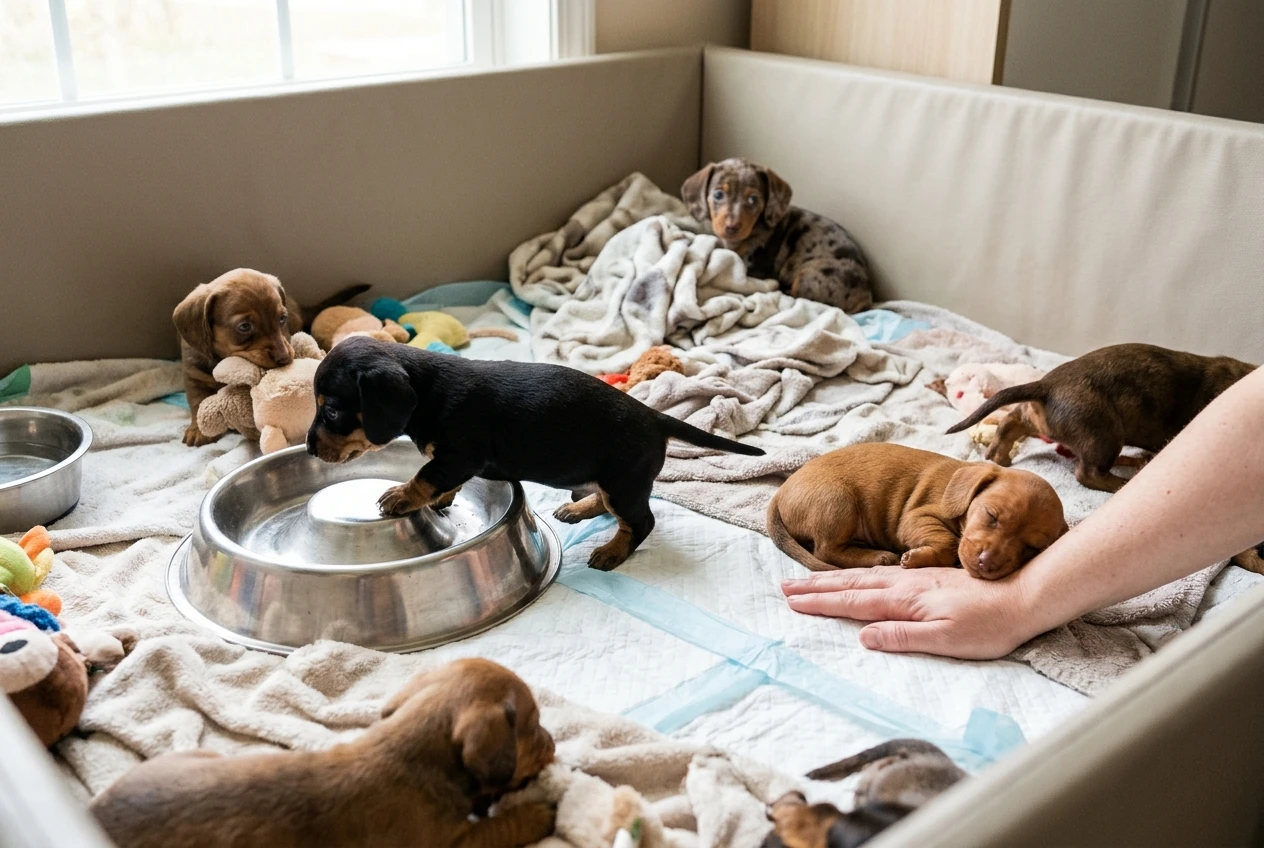
A litter of dachshund puppies in a whelping pen with soft bedding, each doing something different: one boldly climbing into a food bowl, one watching warily from the corner, one asleep on a person's hand, in bright natural window light.

Breeding choices matter too. Temperament is partly inherited, so the dispositions of the parents are worth asking about. Our article on ethical dachshund breeding looks at why this is part of responsible breeding.

Is a dachshund right for your household? Honest signs it is, and signs it isn’t

A dachshund is likely to suit you if:

  • Someone is home for much of the day, or you can arrange reliable company for the dog.
  • You find a dog with opinions entertaining and can stay patient through training.
  • Your home can accommodate ramps or steps and limits on jumping and stairs.
  • You want a close companion that follows you around and sleeps near you.
  • Your neighbors can tolerate some barking, or you live with enough space that it will not cause conflict.

A dachshund may be a poor match if:

  • The household is empty for ten hours a day, five days a week.
  • You expect a dog that obeys instantly and reliably off leash.
  • You want a quiet dog, or you live somewhere that cannot tolerate barking.
  • You have a precious garden and no plan to protect it.
  • Very small children will have unsupervised access to the dog.
  • You want to guarantee a particular personality in advance.

If the second list describes your situation, that is useful information, and it is better to learn it now than after the puppy arrives. Other breeds or an older dog with a known temperament may be a better fit.

How to read a puppy’s temperament before you bring one home

Temperament cannot be known for certain at eight weeks, but you can learn a good deal by watching and asking questions.

Watch how the puppy behaves in a few settings. Does it approach people with curiosity, hang back, or hide? How does it react to a sudden sound, like a dropped spoon? Is it comfortable being gently held, and does it recover quickly after being startled? A puppy that is neither frantic nor frozen is usually coping well.

Ask the breeder:

  • How the puppies have been handled and socialized so far.
  • What the parents are like, and whether you can meet at least the mother.
  • What each puppy’s personality has looked like so far, and which puppy might suit your household.
  • What kind of home the breeder thinks each puppy would do well in.

Be open about your own life. Tell the breeder who lives at home, how long the dog would be alone and what your experience is. A good breeder uses that to guide you toward a puppy that matches, which may mean recommending a different puppy from the one you fell for in the photos, or telling you to wait for a later litter.

Ready to take the next step?

If a dachshund sounds like a good fit for your home, the breeder’s puppy availability page lists current and upcoming litters. You are also welcome to get in touch with questions about the puppies, the parents or whether a particular dog would suit your household.

If you are getting ready for a puppy, the first-time dachshund owner guide walks through what to prepare before the puppy comes home.

Your Dachshund Puppy’s First Seven Days at Home, Day by Day

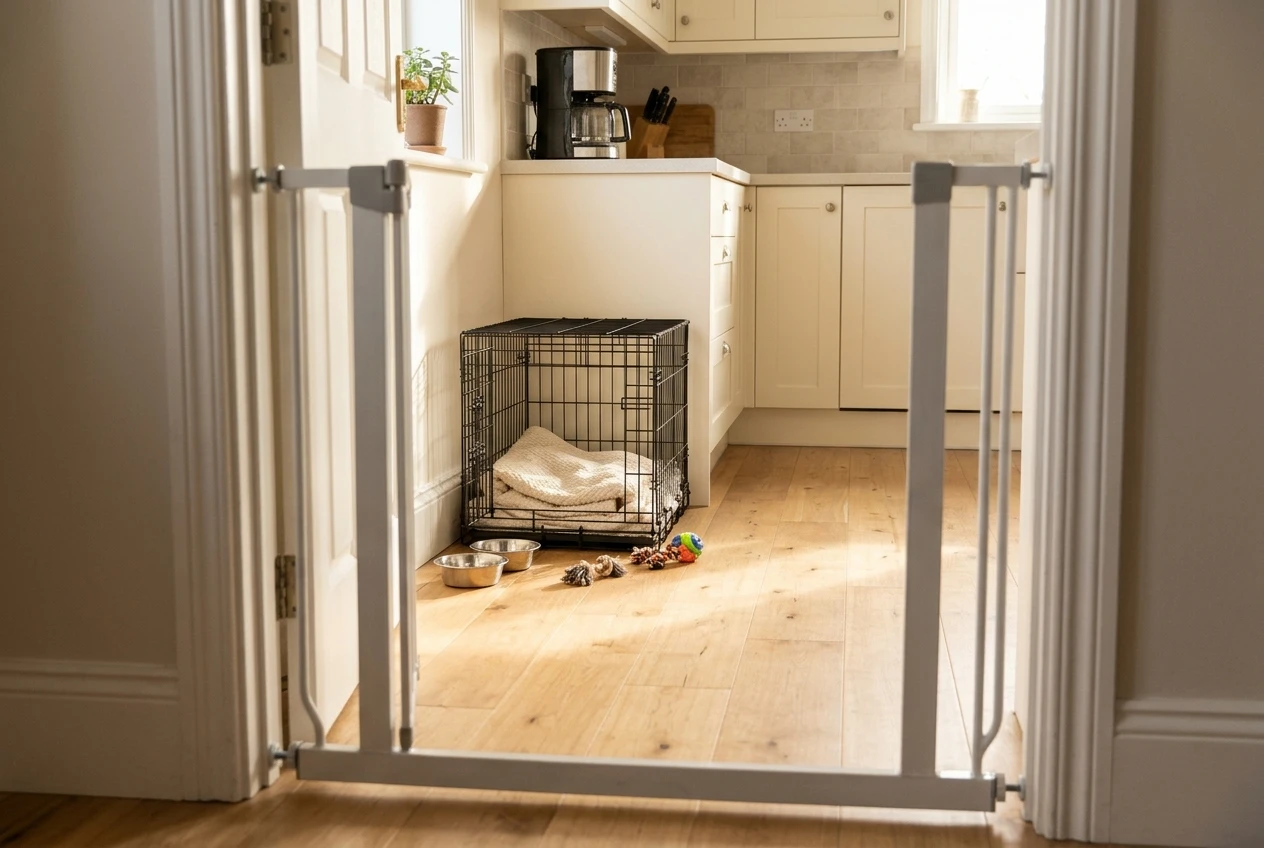
A tidy kitchen corner with a baby gate across the doorway, inside it a small wire crate with a divider, a folded cream blanket, two shallow steel bowls and a few small chew toys on a

Bringing a puppy home is exciting, and the first week with a dachshund puppy goes best when the days follow a simple order. A young dachshund needs sleep, a predictable potty routine, familiar food and protection for a long spine. Most of the rest can wait until the puppy has settled in.

This walkthrough goes day by day, from the car ride to the end of the first week. Puppies vary, so treat the days as a rough sequence and let your own puppy set the pace.

Before the car ride: one safe room, a crate and the basics

Set up before the puppy arrives, so that you are not shopping while a nervous eight-to-twelve-week-old watches you. Choose one room as the puppy’s base, ideally one with an easy-to-clean floor, close to the door you will use for potty trips. A kitchen or a hallway with a baby gate works well.

A tidy kitchen corner with a baby gate across the doorway, inside it a small wire crate with a divider, a folded cream blanket, two shallow steel bowls and a few small chew toys on a light wood floor, soft morning window light.

Gather these things:

  • A crate big enough for the puppy to stand, turn around and lie down, but not much larger. Too much space makes toilet accidents more likely. Many families buy a crate with a divider so it can grow with the puppy.
  • A small, soft bed or blanket that fits the crate.
  • The same food the puppy has been eating, plus two shallow bowls, one for food and one for water.
  • A collar or harness and a light leash. A harness is kinder on a dachshund’s long neck and back.
  • Chew toys sized for a small mouth, and a few safe things to carry around and play with.
  • Enzyme cleaner for accidents. Ordinary household cleaners can leave a smell that tells the puppy to go there again.
  • A ramp or pet steps for any sofa or bed the puppy will be allowed on later.

Put away electrical cords, shoes and anything small enough to swallow. Dachshunds are curious and low to the ground, and they find things adults forget about.

Also plan who will be home. If you can arrange a few days where someone is around for most of the day, the first week becomes much easier.

Day 1: the ride home, the first potty break and a quiet first evening

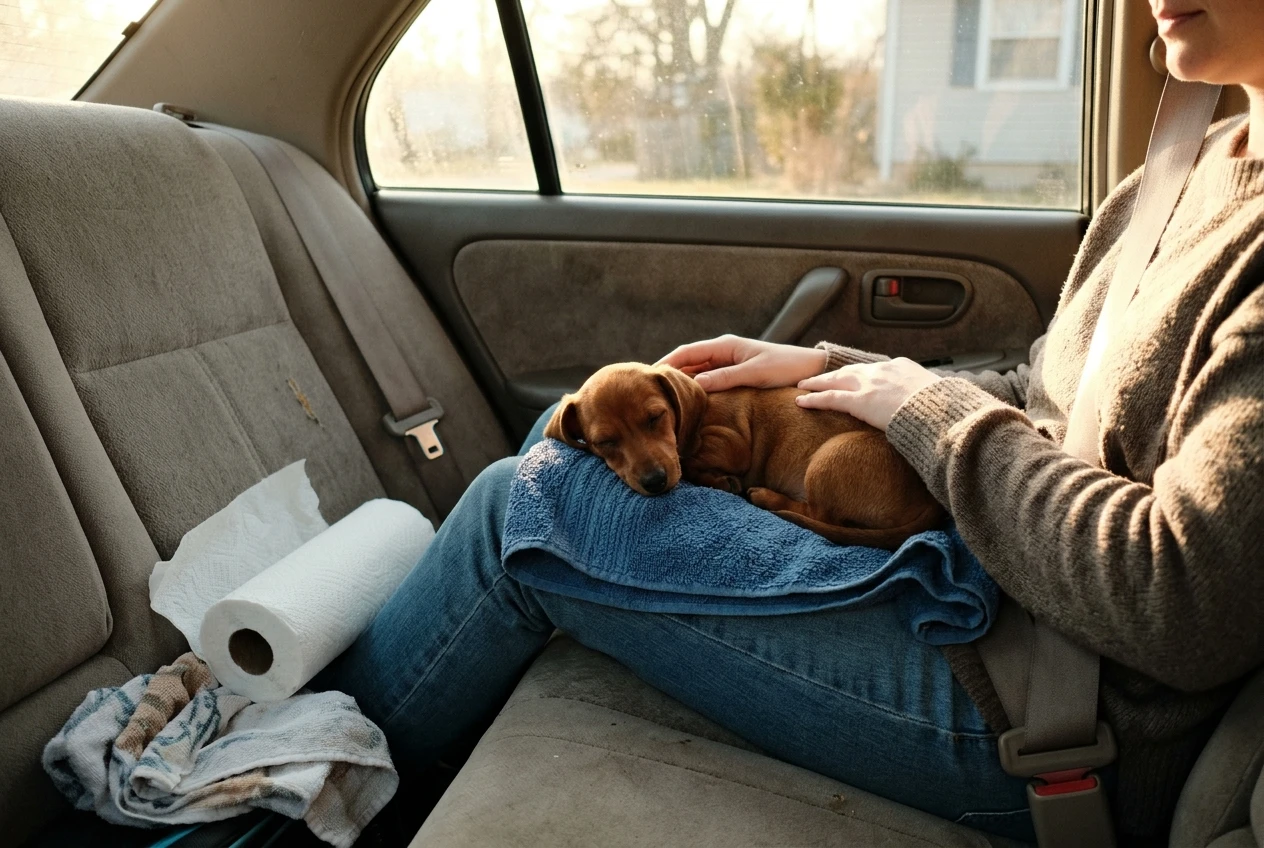
Bring a second person if you can. One person drives and the other holds the puppy on a towel in their lap, or the puppy rides in a small crate or carrier that is secured in the car. Do not let a puppy roam loose in the car. Bring paper towels, a spare towel and a small bag in case of car sickness, which is common in young puppies.

A passenger in a parked car's back seat holding a small red dachshund puppy curled on a folded blue towel in their lap, with paper towels and a spare towel beside them, warm afternoon light through the car window.

When you arrive, carry the puppy straight to the spot in your yard or street where you want potty trips to happen. Stand still, let the puppy sniff, and wait. When the puppy goes, say a calm word of praise and offer a small treat. This first success sets the pattern.

Then bring the puppy into the safe room. Let the puppy explore the room at its own speed. Resist the urge to introduce every family member, neighbor and cousin on day one. A puppy who has just left its mother and littermates is tired and unsure, and a calm room helps more than a party.

Some practical notes for the rest of the day:

  • Offer a small meal at the usual time, using the food the puppy was already eating. Excitement can reduce appetite, so a puppy who eats a little is fine.
  • Take the puppy out after every meal, after every nap and after every play session. In the early days that often means every hour or so while awake.
  • Keep play short. Puppies tire quickly and then get cranky, and a sleepy puppy is a normal puppy.
  • Handle the puppy gently, with one hand under the chest and the other supporting the hindquarters. Never lift a dachshund by the front legs or scoop it up with the back hanging down.

In the evening, keep things dull. Dim lights, quiet voices, a last potty trip, and then the crate.

Night 1 and 2: crate sleeping, crying and what actually helps

Your puppy has probably never slept alone before, so some crying is normal. Put the crate in your bedroom, or right outside the door, for the first few nights. Hearing and smelling you nearby often calms a puppy enough to sleep. You can move the crate gradually later if you want it elsewhere.

A few things help:

  • Put a warm, snug blanket in the crate. Some owners tuck in a soft toy. Avoid anything the puppy could tear and swallow.
  • Take water away about an hour before bedtime, and make the last potty trip just before you settle the puppy.
  • Expect to get up once or twice in the night. A young puppy cannot hold its bladder until morning. Keep these trips quiet: no play, no talking, straight out and straight back in.
  • If the puppy cries when you have already taken it out, wait for a short pause in the noise before you respond. Letting out a puppy in the middle of loud crying teaches that crying opens the door.

Puppies who cry hard and continuously for a long time may need a potty trip, or may simply be frightened. Check for either, then settle them again without fuss. Most puppies sleep better by the second or third night.

Never use the crate as punishment. It should be the puppy’s own bedroom, with a few treats tossed in during the day so that going in feels good.

Days 2 and 3: building a potty routine and a feeding rhythm

Now you can shape the routine. A puppy this age eats several small meals a day, and the number matters less than keeping it steady. If you got your puppy from a breeder, keep to the feeding schedule and food they used, and ask them if you are unsure. Switching foods suddenly commonly upsets a small stomach. If you want to change later, do it slowly over a week or more by mixing a little of the new food into the old. Our page on what we feed our dogs covers the thinking behind food choices.

Feed at the same times each day, leave the bowl down for about fifteen to twenty minutes, then pick it up. Regular meals produce regular toilet trips, which makes the potty routine far easier to predict.

A simple daily pattern looks like this:

  1. Wake up, go straight outside.
  2. Breakfast, then outside again.
  3. Short play, then outside.
  4. Nap in the crate or safe room.
  5. Repeat through the day, with a potty trip after each meal, nap and play.
  6. Last potty trip, then bed.

Go to the same spot each time, and stay with the puppy so you can praise the moment it finishes. Accidents will happen. Clean them with enzyme cleaner and do not scold. A puppy who is punished after the fact does not understand why, and may learn to hide when it needs to go.

Watch for the signs that a potty trip is due: circling, sniffing the floor, sudden wandering off, or whining at the door. Dachshunds can be stubborn about toilet training, and consistency is the whole method.

Day 4: introducing the rest of the house, stairs and furniture safely

By day four the puppy is usually a little braver. This is a good time to open up a second room, supervised, while keeping the safe room as the base.

This is also when back safety needs your full attention. Dachshunds have long spines and short legs, and repeated jumping or awkward landings put strain on their backs. Habits formed now will protect the dog for years.

A young dachshund puppy walking up a carpeted pet ramp onto a low grey sofa, while a baby gate blocks a staircase in the background and a rug runner lies over a hardwood floor, bright living room with soft daylight.
  • Stairs: Block them with a gate. Carry the puppy up and down, supporting the chest and hindquarters, until you have decided on a longer-term plan with your vet.
  • Furniture: Do not let the puppy jump on or off sofas and beds. Use a ramp or steps, or keep furniture off limits.
  • Slippery floors: Hardwood and tile make small legs splay. Put down rugs or runner mats on the paths the puppy uses most.
  • Play: Avoid games that make the puppy leap, twist or stand on its back legs. Keep roughhousing off the menu, especially with children.
  • Weight: A lean puppy is easier on the spine. Measure meals rather than guessing, and keep treats small.

If you have children, show them how to sit on the floor and let the puppy come to them. Holding a puppy should happen sitting down, so a wriggle does not turn into a fall. For more general guidance, 10 tips for first-time dachshund puppy owners covers some of the same ground from another angle.

Days 5 and 6: gentle handling, short visitors and first car or vet trip planning

By now the puppy knows the rhythm of the house, so it is time to build some social confidence, gently.

A person sitting cross-legged on the floor gently holding a dachshund puppy's paw while offering a tiny treat from the other hand, the puppy calm and relaxed on a soft rug, warm indoor light.

Practice handling for a minute or two each day. Touch the paws, look at the ears, lift the lips, and run a hand along the body, always followed by a treat. These small sessions make later nail trims and vet exams easier.

Invite one or two calm visitors for short visits. Ask them to sit down and let the puppy approach. Keep each visit brief and end it before the puppy is overtired. Avoid dog parks and places where unvaccinated dogs gather until your vet says the vaccine schedule allows it.

This is also the time to plan the first vet visit if you have not already booked it. Bring any health records from the breeder, and write down questions about food, vaccines, parasite prevention and back care. Ask the vet about the safest timing for socializing and for stairs.

For the car trip, bring a towel, paper towels and a carrier or a secured crate. Keep the first trip short, and if you can, make one or two very short practice drives first, ending somewhere pleasant. A puppy who only rides in the car to the vet will start to dislike it.

Day 7: what a settled week looks like and when to call your breeder or vet

By the end of the first week, most puppies have a recognizable routine. You may see:

  • Eating at regular times with a good appetite
  • Fewer accidents, with the puppy sometimes heading to the door itself
  • Longer stretches of sleep at night, even if you still get up once
  • More confident play and interest in toys
  • A puppy who greets you, then settles in the safe room

Not every puppy will tick every box, and accidents continue for weeks. Progress is uneven, and a good day followed by a bad one is normal.

Contact your breeder for questions about food, routine, sleep and behavior. They know the puppy’s background and are usually glad to hear how it is going. Our article 10 things your dachshund breeder wants you to know explains why we like to stay in touch.

Call your vet promptly if you see any of the following:

  • Refusing food for a day, or repeated vomiting or diarrhea
  • Unusual tiredness, weakness or shakiness, especially in a small puppy
  • Coughing, labored breathing, or discharge from the eyes or nose
  • Straining to pass urine or stool, or no toilet trips at all

Back problems need quick attention. If your puppy yelps when picked up, hunches, seems reluctant to move, drags a back leg, or wobbles, see a vet the same day. Early treatment makes a significant difference to the outcome.

The first week asks a lot of both of you, and it gets easier. Keep the days simple, protect that long back, and let your puppy learn that your home is a safe place.

If you have questions about your puppy’s first week, or you are still looking for the right dachshund puppy, get in touch with us through our site and we will happily talk it through with you.

First Time Dachshund Owner

Portrait of a Dachshund sitting on a cozy blanket with a warm home setting in the background.
Dachshund in a rustic German countryside, showcasing the breed's origins as badger hunters.

Getting to know the Dachshund isn’t just about those adorable, long bodies and floppy ears. This breed brings with it a rich history that adds a whole lot of charm beyond the cuteness overload. Originating from Germany around the 15th century, Dachshunds were bred as hunters, specifically for badgers. This lineage gives them a bold, curious nature that’s still evident today.

Getting to know the Dachshund isn’t just about those adorable, long bodies and floppy ears. This breed brings with it a rich history that adds a whole lot of charm beyond the cuteness overload. Originating from Germany around the 15th century, Dachshunds were bred as hunters, specifically for badgers. This lineage gives them a bold, curious nature that’s still evident today.

Dachshunds come in a variety of shapes and sizes, but their distinctive features remain constant. Often referred to as ‘wiener dogs’ or ‘sausage dogs,’ their unique shape is unmistakable and actually quite functional for their hunting roots. These dogs are known for being loyal, but also a little independent—okay, maybe a lot. They’ve got stamina and a strong will, which means they may sometimes challenge your patience but always reward with loads of affection.

A group of Dachshunds with smooth, long-haired, and wirehaired coats sitting together in a park.

Health-wise, knowing the common issues that could pop up can really help you stay on top of your pet’s wellness. Dachshunds are prone to back issues due to their elongated spine, and obesity is a no-no as it increases the risk of serious health conditions. Keeping your pet fit and trim is key to a happy, healthy life. Typically, these pups live anywhere from 12 to 16 years, so get ready for many fun-filled, devoted years together.

One thing’s for sure: Dachshunds make amazing family pets. With their spirited and sometimes mischievous personalities, they bring joy and entertainment to any household. They’re affectionate, good with kids, and can adapt well to various living situations, from apartments to larger homes. Just remember, they have no idea they’re a small breed—they think they can rule the world, which makes them all the more lovable.

Preparing Your Home for a Dachshund: Essentials and More

A playful Dachshund exploring a pet-proofed living room with toys and baby gates in place.

Before bringing your Dachshund home, creating a safe and welcoming environment ranks as priority number one. Think of it like prepping for a tiny explorer who’s about to make your house their new playground. These curious canines love to scuttle around every nook and cranny. So, first order of business: keep hazardous objects like cleaning supplies and small items out of reach.

Equipping your home with the right accessories can make a world of difference. A comfy bed suited for their love of burrowing and cozying up is a must-have. Toys, particularly ones that stimulate their active minds, will keep them happy and engaged. Quality chew toys are fantastic to satisfy their need to gnaw.

Dachshund-proofing your living space might sound like a bit of work, but it’s worth it. Look out for things like loose wires and small spaces they could get stuck in. Baby gates can be great at keeping them away from staircases and certain areas while they learn the house rules.

Don’t forget the crucial first vet visit. This is when vaccinations and health checks come into play. It’s also a perfect time to discuss dietary requirements and any preventative care your new furry friend might need. Getting this routine set up early will save you loads of worry down the line and keep you well-informed on how to care for your new companion.

The Basics of Dachshund Care: Nutrition, Grooming, and Exercise

A Dachshund being groomed with a brush, showcasing care for its smooth coat.

Feeding your Dachshund right is the backbone of great care. Their small frames pack a big appetite, so choosing a well-balanced diet specifically designed for small breeds can help keep them in top shape. Make sure their meals are packed with the right nutrients to support their lively demeanor and avoid overfeeding, as extra weight can spell trouble for their spines.

Grooming varies with the type of coat your Dachshund sport—be it smooth, long-haired, or wirehaired. Regular brushing, especially for those with longer or wiry coats, keeps them looking sharp and reduces shedding. Those nails? Keep them trimmed, because when those little legs are on the move, neat paws make all the difference.

Exercise isn’t just vital—it’s part of their doggy DNA. Daily walks are key, but don’t underestimate the benefits of playtime, which boosts their mental happiness. These hounds love to sniff and explore, so mix it up with different walking paths or fun hide-and-seek games indoors during bad weather days.

Knowing the signs of behavioral issues and addressing them promptly is a biggie. Barking excessively or signs of anxiety when alone are clues that your pup needs more attention or outlets for their energy. Sometimes, a bit of extra playtime or some interactive toys can work wonders to keep that spirited nature positively channeled.

Forging a Lasting Bond: Training and Socialization Adventures

Training your Dachshund may seem like an adventure, but with a bit of patience and consistency, it’s absolutely rewarding. House training should be among the first skills you tackle, and keeping a regular schedule will help your pup catch on quick. Accidents might happen, but staying calm and positive makes the teaching more effective.

Introducing your new buddy to different people and pets is a mission you’ll want to start early. Socializing them helps build confidence and ease out any potential nerves they might have. Whether it’s a trip to the dog park or having friends over, each experience builds their assurance.

Harnessing positive reinforcement works wonders with these little guys. Dachshunds respond well to treats, praise, and playtime rewards when they ace a new command. Keeping training sessions short and fun holds their attention and leads to better results.

A happy Dachshund playing fetch with its owner at a dog park, showcasing training and socialization.

Taking your dog out on social outings and community events isn’t just for their enjoyment, it strengthens that bond between you two. Plus, a change of scene is always refreshing. Be it a stroll in a local pet-friendly cafĂ© or joining group classes, these experiences broaden their world and yours, sealing the lifelong friendship you’re building.