
Dachshunds were bred with a long body and short legs, and that shape puts more mechanical load on the spine than the build of most other dogs. The same genetics that give a dachshund its look also make the cushioning discs between the vertebrae wear out earlier. You cannot change that. You can change how much daily strain those discs take, and that is the practical side of how to prevent back problems in dachshunds.
This guide covers the routine: stairs, furniture, lifting, weight, harnesses, play, and the early signs that something is wrong. None of it replaces your vet, but nearly all of it costs nothing and takes a few seconds a day.
Why a dachshund’s long back needs different care from other breeds
Between each pair of vertebrae sits a disc, a tough outer ring around a softer center. In dachshunds, the discs tend to lose moisture and harden at a young age, sometimes well before the dog is middle-aged. A hardened disc absorbs shock poorly. A jump off a sofa, a awkward twist, or a hard landing can push disc material toward the spinal cord. That is intervertebral disc disease, usually shortened to IVDD, and it is the main back problem in the breed.
Two things follow from this. First, the risk exists whether or not your dog has ever shown a symptom, so prevention starts the day a puppy comes home. Second, the damage often builds up from many small stresses and then shows itself after one ordinary movement. Owners often say the dog “just jumped off the couch like always.” The couch was not the whole cause, but it was the last of many impacts.
Most of what follows comes down to three goals: fewer impacts, a lean body, and a spine that stays supported when you handle or restrain the dog.
Stairs, sofas and beds: how to stop the jumping without stopping the fun
Dachshunds are athletic and bold, and they will launch off any surface they can reach. Telling a dachshund not to jump does not work, so change the environment instead.
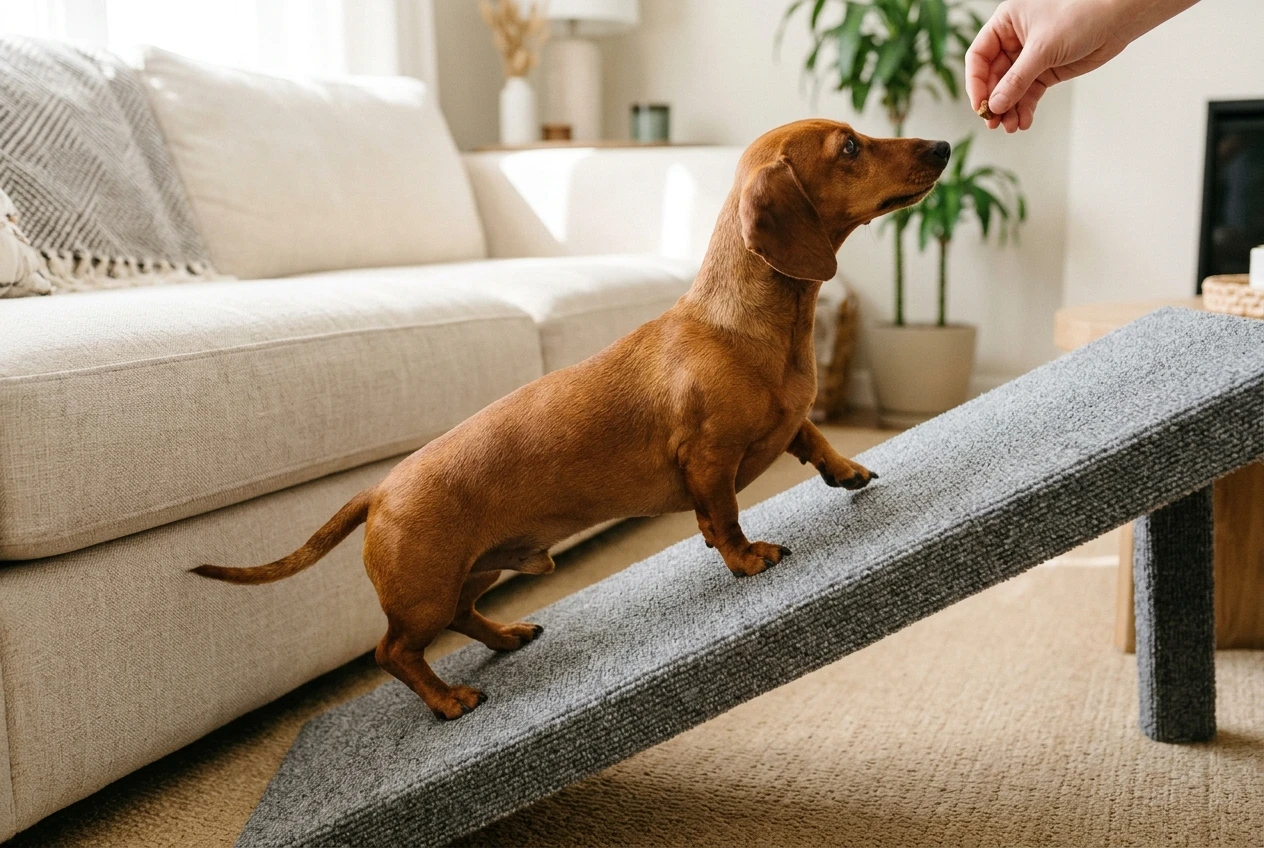
- Ramps and pet steps for furniture. Put a ramp or a set of sturdy steps beside the sofa and the bed. Choose a ramp with a textured, non-slip surface and a gentle slope. A short, steep ramp is hard on the dog’s back too.
- Teach the ramp with treats. Lure your dog up and down a few times a day for a week or two. Most dachshunds adopt it quickly once it is the easiest route to your lap.
- Block access when you cannot supervise. Close the bedroom door, use a baby gate, or put the dog in a pen. A dog that cannot reach the bed cannot jump off it.
- Carry on stairs when practical. Full flights of stairs, especially going down, put repeated jarring on the spine. If your home has stairs you use constantly, a gate at the top and bottom for puppies and carrying a small adult is reasonable. Older dogs and dogs with a back history deserve extra caution.
- Teach a “wait” at doors, car edges and sofa edges. A dachshund that pauses before leaping gives you time to lift it down.
Floors matter as well. A dachshund that scrambles on tile or hardwood twists its back to catch itself. Put runners or non-slip mats on the routes your dog uses most, and keep the nails trimmed so the toes grip. Long hair between the paw pads can also cause slipping, so ask your groomer or vet to show you how to trim it.
Fun does not have to stop. Move the jumping games to the floor, where chasing, sniffing, and hide-and-seek keep the dog busy at ground level.
The right way to pick up and carry a dachshund
Every dachshund gets picked up, so how you do it counts. The aim is to keep the spine level and supported, with no dangling and no twisting.
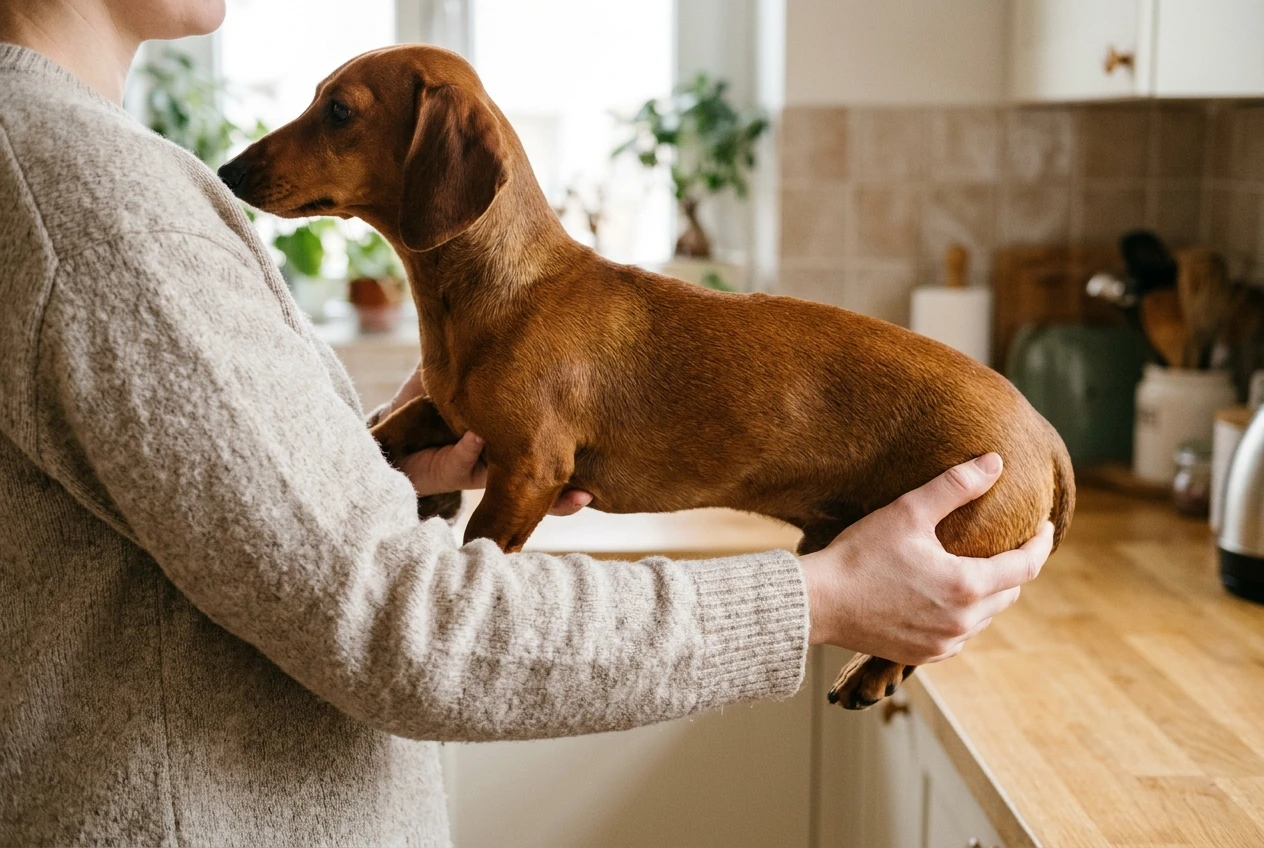
- Approach the dog calmly and let it see you, so it does not wriggle suddenly.
- Slide one hand under the chest, between the front legs, with your forearm along the belly.
- Place the other hand under the hindquarters, supporting the rear legs and bottom.
- Lift so the back stays horizontal, then bring the dog in against your body.
- Lower the dog the same way, letting all four feet touch the ground together.
Avoid lifting by the front legs, scooping under the armpits alone so the back end hangs, or holding the dog upright like a baby with the hindquarters dropping. Ask children to sit on the floor and have the dog placed in their lap rather than carry it. Small children should not carry a dachshund at all, because a squirming dog is easy to drop, and a fall is dangerous for that spine.
Teach every person in the household, and visitors who want to cuddle the puppy, to use the two-handed hold. It takes about a minute to demonstrate.
Weight and diet: why extra pounds land on the spine
Every extra pound a dachshund carries pulls on the same long, unsupported spine. Excess weight also reduces the muscle tone along the belly and back that helps stabilize the vertebrae. A lean dachshund is easier on its discs than an overweight one, and it is a factor you control entirely.
Check your dog’s body condition regularly:
- You should be able to feel the ribs under a thin layer of padding without pressing hard.
- Looking from above, you should see a visible waist behind the ribs.
- From the side, the belly should tuck up slightly instead of hanging level or sagging.
If you cannot find the ribs or the waist, talk to your vet about a target weight and a feeding plan. Measure meals with a scale or a measuring cup instead of guessing, count treats as part of the daily food, and keep table scraps out of the picture. Dachshunds are experts at looking hungry. A dog that begs is not necessarily a dog that is underfed.
What goes into the bowl matters too. Our page on what we feed our dogs covers feeding in detail, so there is no need to repeat it here. The principle for the spine is simple: feed a quality diet in measured amounts and adjust portions to the dog’s body condition, not to its pleading.
Harness, leash and play: what protects the neck and back, and what to avoid
A collar concentrates every pull on the neck, and a dachshund that lunges at a squirrel can strain the cervical spine. The neck has discs too. For daily walks, a well-fitted harness spreads the force across the chest instead.
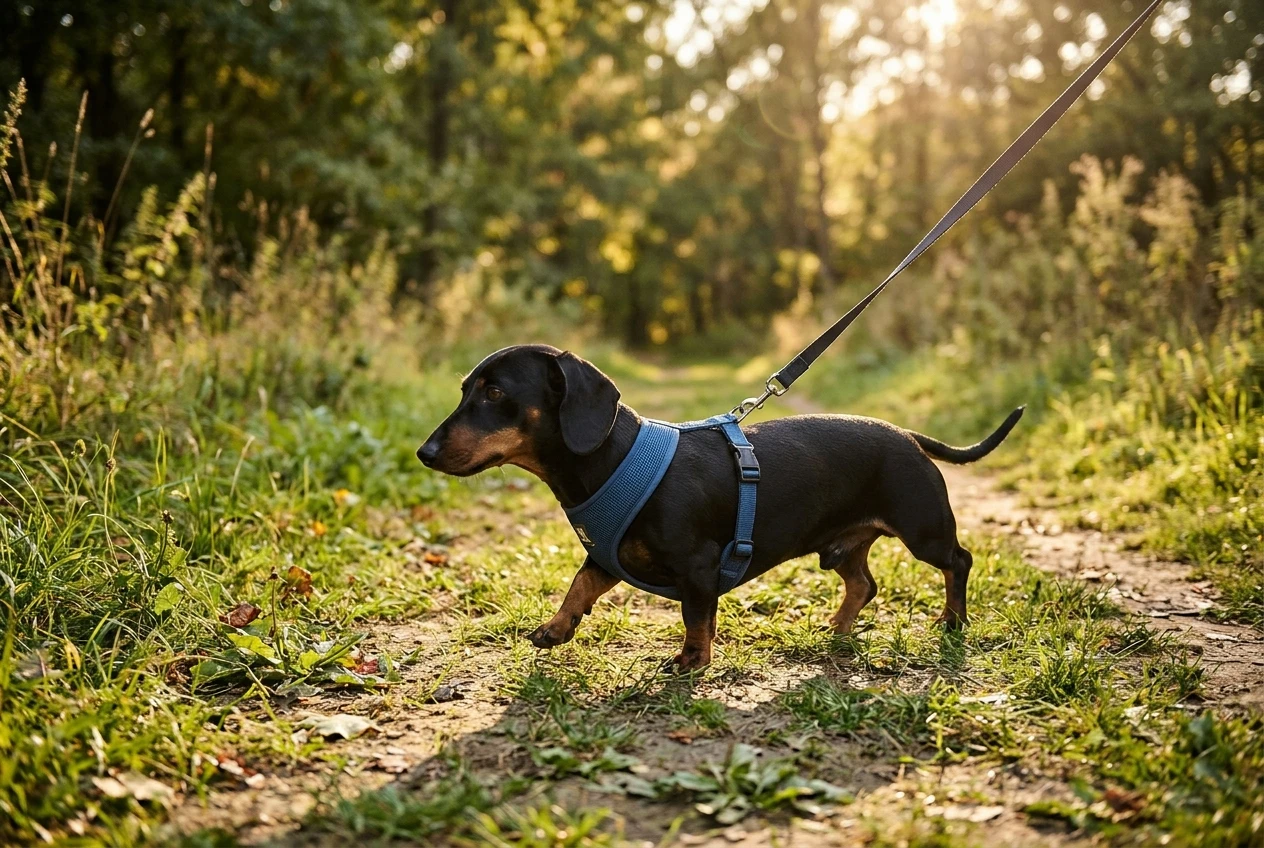
What to look for in a harness:
- It sits across the chest and behind the front legs without pressing on the throat.
- It fits snugly enough that the dog cannot back out, but you can slide two fingers underneath.
- It does not squeeze the ribs or restrict the shoulders as the dog walks.
- It is sized for a long, narrow body. Many harnesses are designed for rounder breeds and fit dachshunds badly, so check the fit on your actual dog.
Choose a standard fixed-length leash over a retractable one. A retractable leash lets the dog hit the end at speed and then stops it abruptly, which jerks the body. Train loose-leash walking so the dog is not hauling on the harness either.
Play deserves the same attention:
- Avoid games that make the dog jump for a toy or leap in the air to catch a ball.
- Skip tug-of-war that lifts the dog’s front end off the floor or involves hard twisting.
- Be careful around much larger dogs. A friendly body slam from a big playmate can injure a dachshund.
- Do not encourage begging on the hind legs. Sitting up on the back legs puts the spine in an unnatural curve.
Do keep exercise up. Regular walks on level ground build the muscle that supports the spine. Moderate, steady exercise is better than occasional bursts of intense running, and young puppies should not be pushed on long or strenuous walks while their bones and joints are still developing. Ask your vet how much exercise suits your dog’s age.
Puppy-proofing the home for a growing spine
A puppy needs a home where the safe choice is also the easy one. Before the puppy arrives, walk through each room and ask where the dog could climb up, jump down, or slip.
Set up these basics:
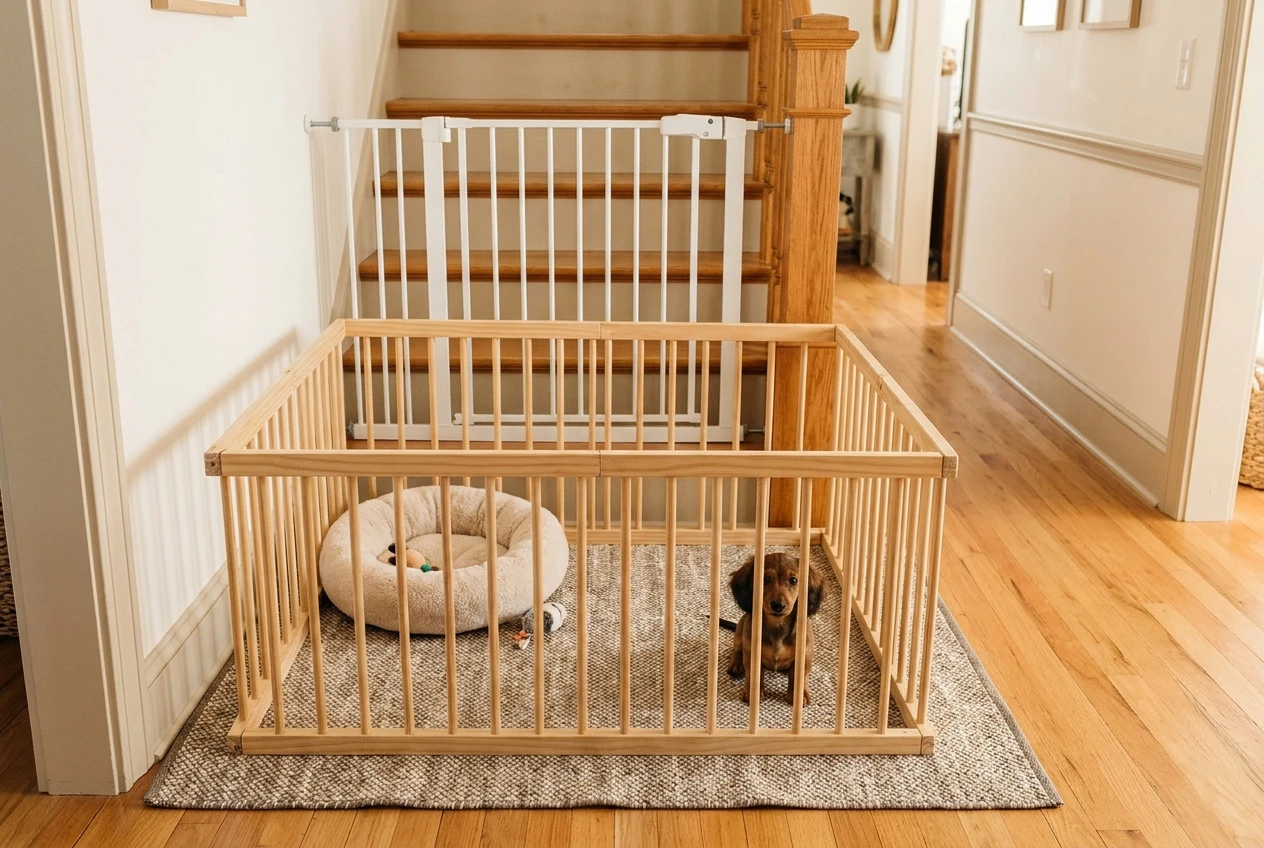
- Baby gates at the top and bottom of staircases.
- A ramp or step beside the sofa and bed, with the puppy introduced to it in the first days.
- A playpen or a gated area with non-slip flooring for times you cannot watch.
- Rugs or mats on slippery floors.
- A low, stable crate or bed that does not need climbing into.
- A rule that nobody carries the puppy except with the two-handed hold.
The arrival period is when habits form. Our guide to the first seven days at home with a dachshund puppy covers the daily schedule. Add the spine-protecting habits to that routine from day one, so the ramp, the gate, and the careful lift are simply how the household works. A puppy that has never been allowed to jump off the sofa does not miss it.
Early warning signs of back pain and when to call the vet right away
Dachshunds are stoic, and back pain is easy to miss. Watch for changes in behavior as well as obvious symptoms. Early signs can include:
- Reluctance to jump, climb stairs, or go for walks it used to enjoy.
- A hunched or tucked posture, with the head held low.
- Trembling, panting, or restlessness without an obvious cause.
- A yelp when picked up, touched along the back, or when moving.
- Stiffness, a tense belly, or refusing to eat.
- Unwillingness to turn the head, which can point to the neck.
Any of these is a reason to call your vet the same day. Mild pain can still signal a disc problem, and early treatment gives the best chance of avoiding a worse episode. Limit the dog’s activity while you wait, and do not give human painkillers. Medications such as ibuprofen and acetaminophen can be toxic to dogs. Only give what your vet prescribes.
Go to the vet or an emergency clinic immediately if you see:
- Wobbling, dragging, or crossing of the back legs.
- Knuckling over on the paws, so the dog walks on the tops of its feet.
- Sudden inability to walk or stand.
- Loss of control of the bladder or bowels.
- Severe pain, crying out, or paralysis.
With disc injuries, speed matters. Hours can make a difference to recovery, so do not wait to see whether it improves overnight. Treatment depends on the severity and may involve strict rest, medication, or surgery, and that decision belongs to your vet.
What a breeder looks for in parent dogs to lower risk
Daily care lowers the strain on the spine, but genetics set the starting point. This is where a breeder’s choices count most. Responsible breeders pay attention to the parents’ structure, health history, and family lines before planning a litter.
Things worth looking for include:
- Sound, balanced build. A body that is not excessively long, with legs in proportion and a level topline.
- Healthy weight and fitness in the parents. Parents kept lean and in good muscle condition.
- Back health history. Whether the parents, and their close relatives, have had disc problems, and at what age. Breeders who keep records of this can make better pairing decisions.
- Screening where available. Some breeders use veterinary checks, such as spinal radiographs, to look at disc calcification in breeding dogs. Ask your breeder what they do and why.
- Openness. A breeder who answers questions about the parents’ health and lets you see how the dogs live is a good sign.
No breeder can promise a dachshund will never have a back problem, and you should be wary of anyone who does. What a good breeder can do is reduce the odds through careful selection and then support you with advice on raising the puppy. For a fuller look at the standards behind healthy litters, read our article on what ethical dachshund breeding is and why it matters.
If you’re thinking about adding a dachshund puppy to your family, get in touch with us about upcoming litters and ask how we raise our puppies with spine health in mind.